From the Service Bench: Why This Checklist Exists
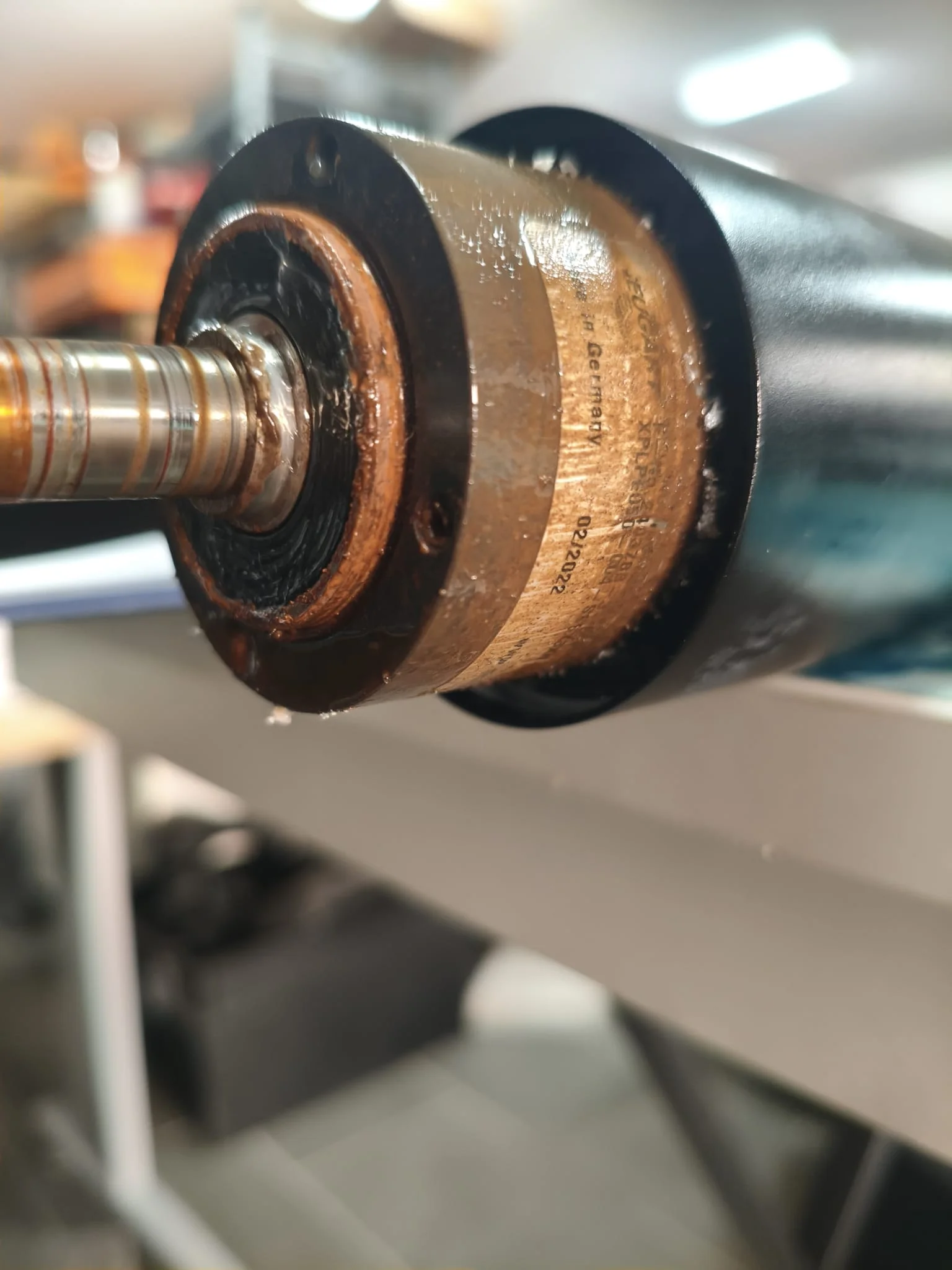
The image above came off our service bench in Marsaskala in January 2026, pulled from a Fliteboard that arrived for a delayed annual service. The end-cap oxidation didn’t happen overnight — it built up across a charter season’s worth of salt-water flushing through a slowly-degrading seal. By the time the board reached us, the motor housing had to be deep-cleaned, anodes replaced, seals refreshed and pressure-tested. The board went back to its yacht in five working days. Without that intervention, the next failure would have been a motor seizure costing more than half the board’s new price.
This guide is the checklist we work to. It’s structured around Fliteboard’s mandatory service intervals, the 6-month rhythm of a Mediterranean charter season, and the real-world failure modes we see most often at our authorised service centre in Malta. Every photograph in this article is from a real Fliteboard that came through our workshop. Every cost figure is what Mercer Yachting actually charges. If you operate a charter yacht with Fliteboards on board, this is the maintenance cadence that keeps boards on the water and warranty cover intact.
For the broader 2026 pricing context, including the new 1-year-or-100-hour commercial warranty cap, see our Fliteboard pricing guide. For the brand comparison against Lift and Awake, see the 2026 superyacht buyer’s guide.
The 6-Month Rhythm of a Charter-Season Fliteboard
A charter-intensity Fliteboard fleet runs on three windows of attention:
- Pre-season (April / early May) — reset the board from winter storage. Run the full Flite Service before guests step on. Software updates, anode replacement, seal refresh, controller pairing, battery cycle baseline.
- Mid-season (July / August) — quick inspection between guest weeks. Anode wastage check, lid-seal visual, hull integrity check, battery cycle and capacity review via the Flite App.
- End-of-season (October / November) — pre-winter service and storage prep. Second Flite Service if the board crossed 100 hours. Battery to long-term storage state of charge. Hull and wing inspection for any season’s impact damage.
Fliteboard’s own service intervals dictate the rhythm. Current Series 3, 2024 range, Marc Newson, Prop C and Flite Jet 1 systems require a 1-year or 100-hour service, whichever comes first. The Flite Jet 2 (Jet C) and Flitescooter C powertrains run on a longer 2-year or 200-hour interval. Older Series 1, 2 and 2.2 boards take a 6-month or 50-hour initial service (whichever first), then 1-year or 100-hour ongoing. Service must be done by an authorised partner or Fliteboard HQ — owner-servicing voids the warranty.
A charter board doing 200 hours a season hits the 100-hour mark partway through July. Under Fliteboard’s 2026 commercial-warranty regime (1 year OR 100 hours, whichever first), that’s the cliff to plan around: either book a mid-season Flite Service to reset documented service status before guests overrun the cap, or accept that any major failure after 100 hours will be out-of-pocket.
Pre-Season Checklist (Early May)
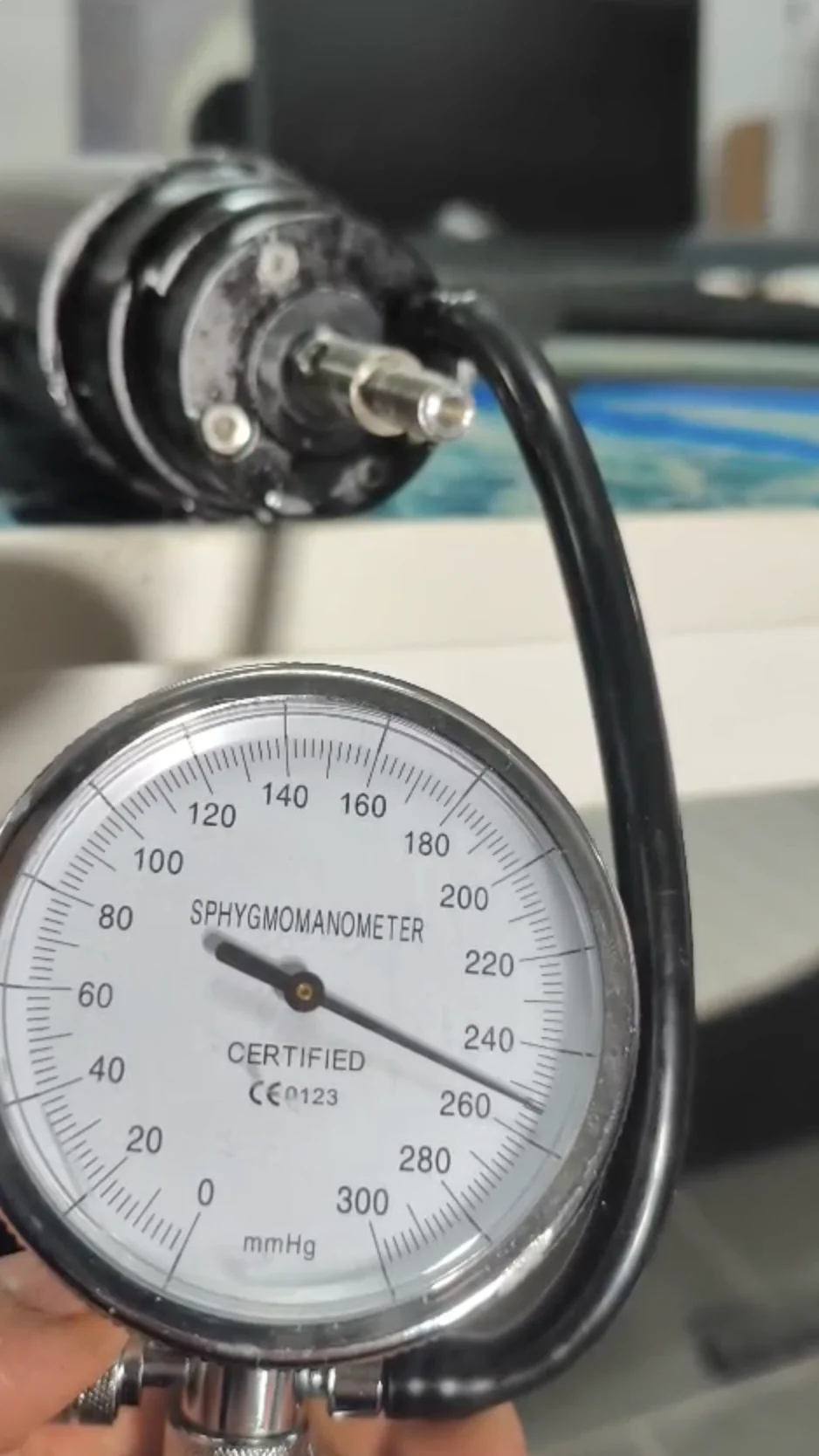
The pre-season Flite Service is non-negotiable. It’s the foundation on which every other piece of the season runs — warranty cover stays intact, the board enters the season with documented service status, and any latent issues from winter storage get caught before guests step on. The full Yearly Preventive Maintenance at our Marsaskala workshop is €568 and covers eight specific tasks:
- Flitebox Inspection and Flitebox Pressure Test — verifies watertight seal integrity (pictured above)
- Flange Check, Shaft and Pin Inspection — catches early bearing wear and misalignment
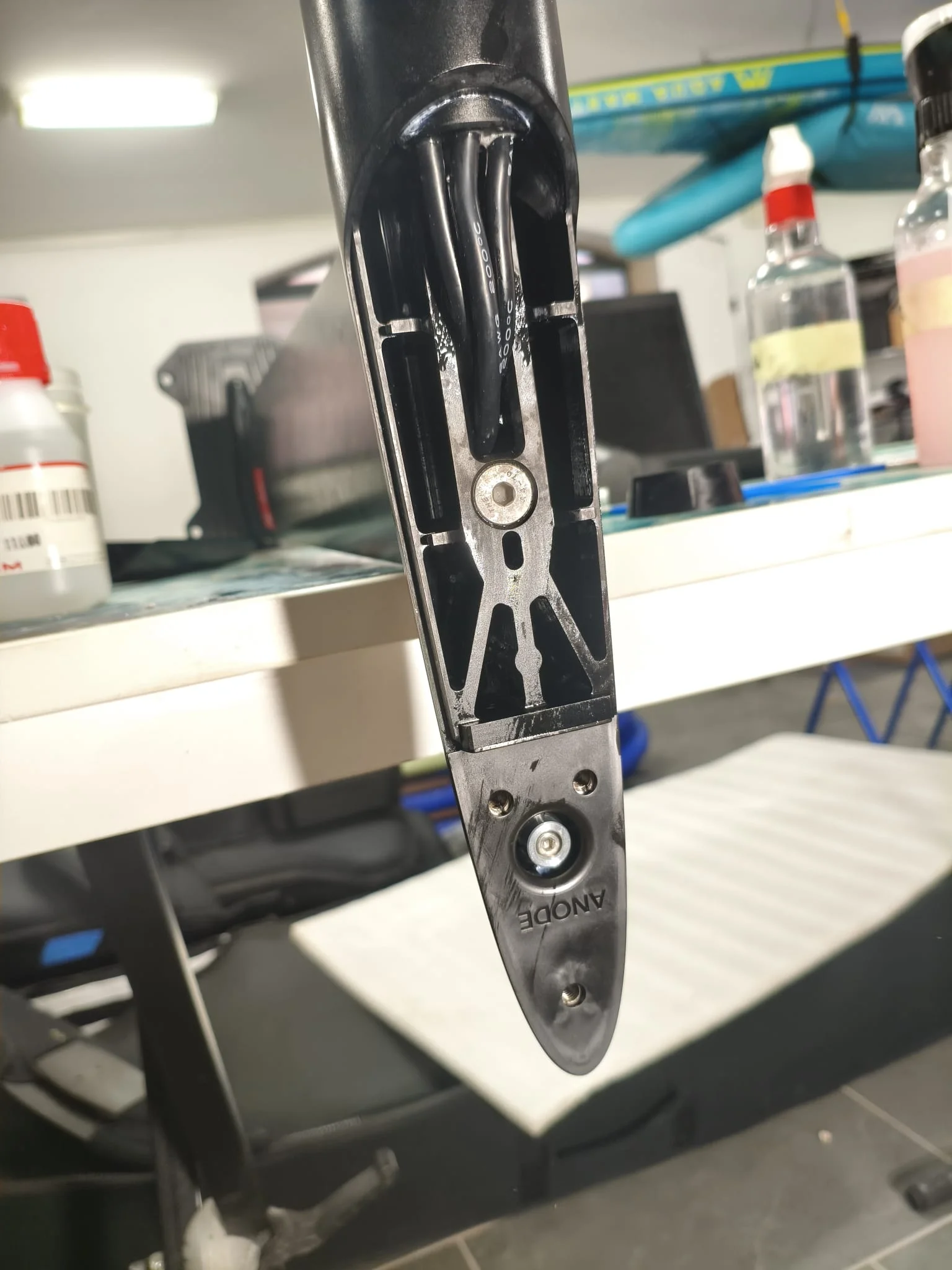
- Propeller, Prop Guard and Anode Change — sets a clean baseline for the season
- All O-Rings Replaced + Refill of Silicon Oil — the seal layer that keeps salt water out of the motor compartment
- Mast and Board Inspection, Upper and Lower — carbon integrity, mast straightness, fitting torque
- Software Updates — pushes the latest firmware to the Flite Controller and Flitebox
- Battery Baseline Check via Flite App — records cycle count + capacity entering the season
- Controller Re-pairing — verifies the Bluetooth handshake and trigger calibration
At the Flitebox pressure test stage, we’ve seen failure rates climb sharply once a board crosses 18 months of Mediterranean charter use without a seal refresh. The pressure gauge tells you in 60 seconds what an end-of-season hauling out would only reveal once damage was done. If your board hasn’t had a documented Flite Service in 12 months — or 100 charter hours, whichever came first — this is where the season starts.
Mid-Season Checklist (July / August)
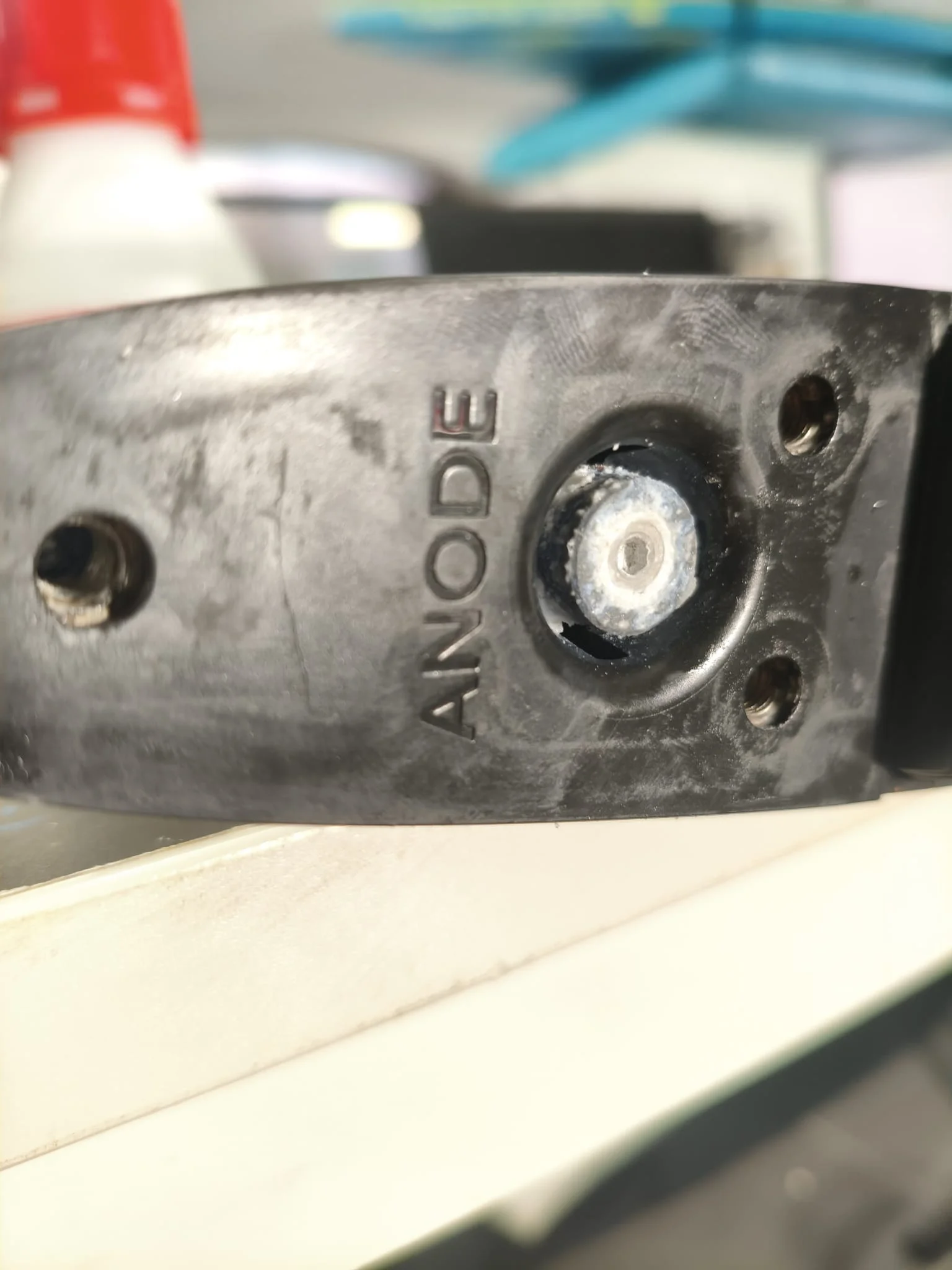
The mid-season check is a 20-minute visual inspection by an authorised technician, not a workshop bench job. It’s the most-skipped service moment in a charter year and the one that produces the most preventable failures we see in Q4. Five checks make the difference:
1. Anode wastage
Anodes are sacrificial — they exist to corrode in place of the motor housing, mast bolts and prop. If they look more than half-wasted at the mid-season inspection, replace them immediately. A €25 anode kit prevents a €1,500 motor housing replacement. The board pictured above had ridden roughly 60 charter hours since its pre-season service — right in the window where anode wastage starts accelerating in 28°C Mediterranean water.
2. Lid-seal and battery-compartment visual
Lift the Flitecell lid and inspect the seal compartment. Any visible distortion, brittleness or salt crystal accumulation means the seal is degrading. Saltwater intrusion into a Flitecell is the most expensive failure in the system — a replacement Flitecell Explore is €3,400; a Sport is €2,400. Both are end-of-warranty events.
3. Hull integrity
One hard touchdown on a wing tip can spall the carbon laminate. Wing-edge damage doesn’t stop the board working immediately, but it propagates fast in salt water. Photograph anything you see and send it to the service desk before the next charter starts.
4. Battery cycle and capacity in the Flite App
The Flite App logs every charge cycle and the battery’s capacity over time. By mid-season, a charter board can have logged 50–80 cycles. Watch for:
- Cycle count crossing the 100-hour commercial warranty threshold
- Capacity dropping below 90% of as-new value (a leading indicator of pack degradation)
- Charge events failing or aborting (battery management system flagging cell imbalance)
5. Foot strap, hand controller and FCS torque check
Vibration loosens bolts. By mid-season, every fastener on the board has experienced thousands of cycles. A torque-wrench pass on the foot-strap inserts, mast-to-board bolts and FCS plug screws takes ten minutes and catches issues before they become “why did this come off mid-ride?” incidents.
End-of-Season Checklist (October / November)
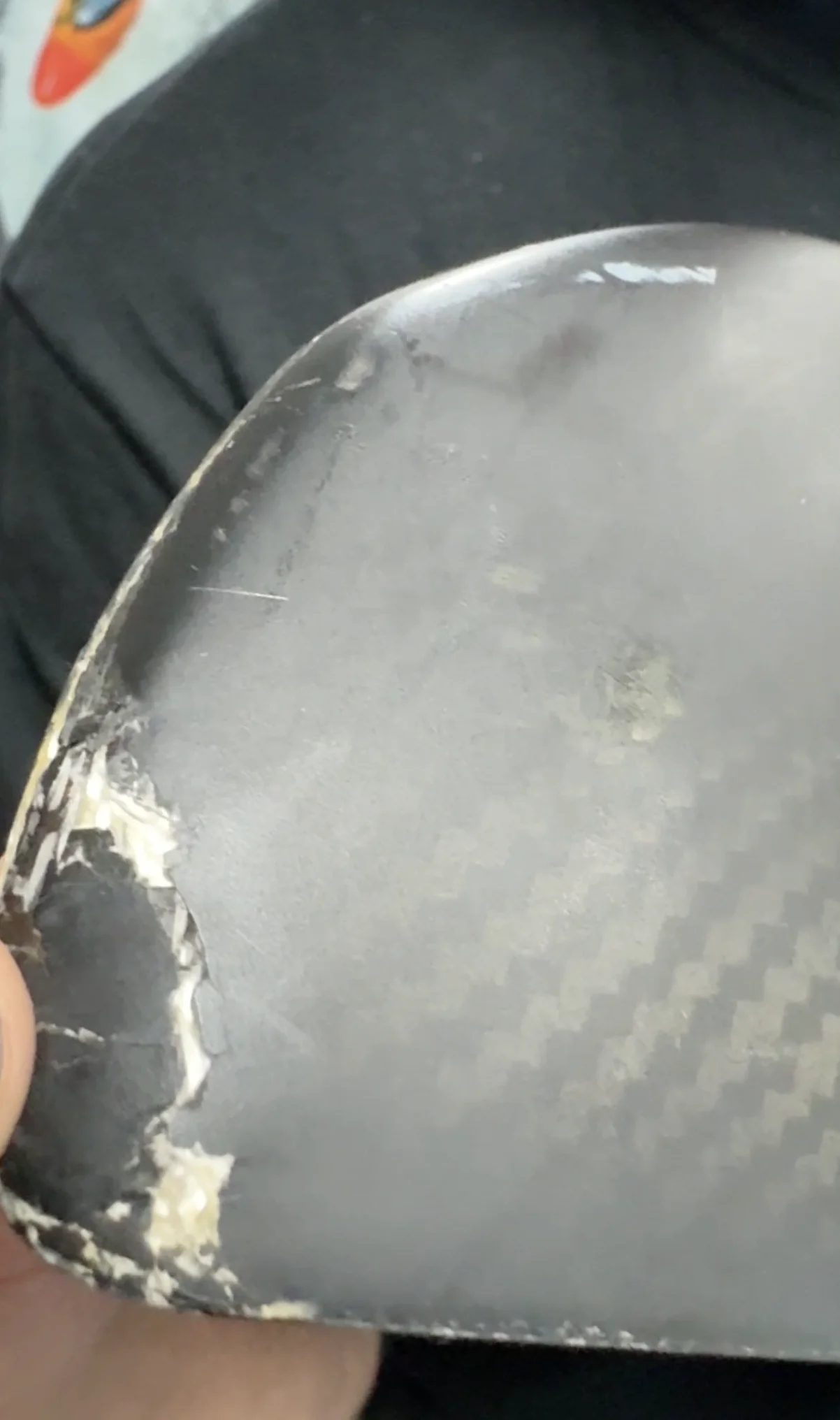
Run a second Flite Service if the board crossed 100 hours during the season. If not, the end-of-season check focuses on detailed inspection and storage preparation. Six tasks:
- Full freshwater flush — before storage, rinse every part of the board, drive, mast and battery enclosure with clean fresh water. Pay attention to the connectors, the FCS plugs and the controller-battery housing.
- Detailed hull inspection — check every wing edge, every mast junction, every visible carbon surface for impact damage, spalling, or stress-fracture lines. A magnifying loupe makes the difference between catching and missing a hairline crack.
- Wing inspection (pictured) — a single hard touchdown over the season can leave a hairline crack that propagates over winter. If you see it now, ship it for carbon repair before December. Fibreglass repair on a board is €540 at our workshop; wing replacement is more.
- Anode replacement — if not already done mid-season, replace before winter storage. Salt water will keep working on a wasted anode even when the board is dry-stored.
- Battery state-of-charge for winter — the most important storage variable. Bring every Flitecell to 50–60% state of charge before storing. Not 100%, not 20%, not flat. Mid-range balanced storage is what keeps the battery management system happy through the off-season.
- Cabinet storage at temperature — store between 5°C and 25°C, ideally 15–20°C. Never below 0°C, never above 50°C. Keep batteries in a cabinet meeting EN 14470 / EN 16121 / EN 16122 (more on that below). For non-commercial yachts, a temperature-controlled marina-side locker works; do not store loose in a yacht garage that gets hot in winter sun.
Flitecell Battery Care — the 6-Month Protocol
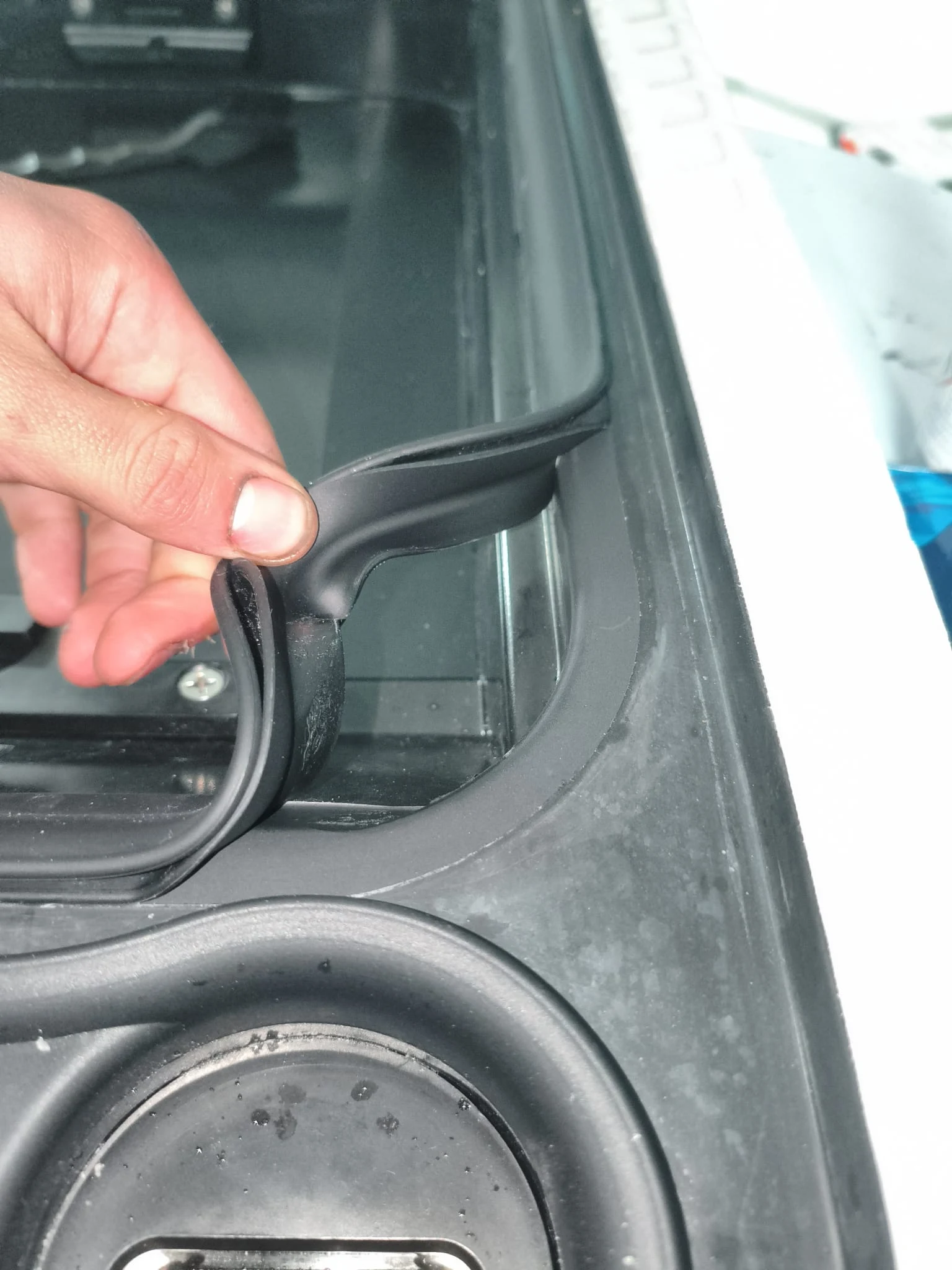
Flitecell lithium-ion packs are precision-built. The seal layer between the lid and the cell compartment is what keeps salt water out of the 50.4–52 V cell stack (50.4 V on the Nano; 52 V nominal on the Sport and Explore). Treat the lid like a watertight bulkhead: never operate with a visibly degraded seal, never store after a salt session without a freshwater rinse, never leave at extreme state of charge for more than two weeks.
Charging discipline
- Ride-to-ride: charge to 80% (or to 100% only if the next ride is within 24 hours). Lithium-ion packs degrade fastest at 100% state of charge.
- Storage longer than two weeks: 50–60% state of charge.
- Winter storage: 50–60% state of charge, room temperature, dry, in a lithium-rated cabinet.
- Mandatory exercise: cycle the battery at least once every three months. A pack left at 0% for months will permanently lose capacity; a pack left at 100% for months will also degrade. The Fliteboard 2-year battery warranty requires evidence of cycling.
Connector and receptacle care
The Flitecell power receptacle is a wear part. Inspect it every service, replace the protective power receptacle cap (€2 from our parts catalogue) before any signs of degradation, and clean the metal contacts of any salt crystal accumulation with isopropyl alcohol. Corroded contacts cause intermittent connection faults that the BMS interprets as cell imbalance — and that triggers safety lockouts mid-ride.
Pressure-test the Flitecell at every annual service
Same principle as the Flitebox pressure test, applied to the battery enclosure. If the seal can’t hold pressure on the bench, it won’t hold water in the marina. Replace the seal before the next session.
What MGN 681 Amendment 1 Means for Battery Storage on Board
The UK MCA’s Marine Guidance Note 681 (M) Amendment 1 — published 19 December 2025 with clarifications added 13 January 2026 — is now the canonical regulatory reference for any commercial yacht carrying eFoils. It applies to yachts complying with Part A of the REG Yacht Code. The headline requirements that change how you store and charge Flitecells:
- Batteries above 100 Wh (every Flitecell qualifies — Nano is 806 Wh, Sport is 1.6 kWh, Explore is 2.1 kWh) must hold third-party conformity (UKCA or equivalent) and comply with IEC 62619 and/or IEC 62620.
- Spare batteries must be stored in dedicated cabinets meeting EN 14470 / EN 16121 / EN 16122 standards with temperature-rise detection, automatic charge cut-off and gas venting.
- The cabinet must allow extinguishing media to be applied without opening — passive thermal containment isn’t enough; active suppression integration is required.
- CCTV plus smoke or gas detectors required in the storage compartment with alarms at a manned control position.
- Crew training in lithium-ion safe operation, storage, damage identification and Li-ion-specific extinguishing.
- 1 January 2027 hard deadline for UK-registered yachts on type-approved charging containers.
For Fliteboard fleets this means active lithium safety boxes — RAMBSS, RACLAN, LiVault — are no longer optional. Flitecells use high-energy-density 21700 lithium-ion cells — the high-power NMC-class chemistry common in EV and marine applications, which delivers higher energy density than LFP but has a lower thermal-runaway threshold. Active containment is what stops a single-cell event from becoming a yacht event. We integrate RAMBSS and RACLAN charging cabinets with every multi-board delivery from Mercer Yachting. See the Lithium Safety hub for the cabinet specification framework.
Common Failure Modes — What We See on the Bench
From hundreds of Flite Services across the Mediterranean charter calendar, four failure modes dominate. Each is preventable with the 6-month checklist above.
1. Salt-water intrusion through degraded seals
By far the most common workshop find. Salt water reaches the motor compartment through an O-ring that wasn’t replaced at the last service. Once water is inside, the motor windings corrode quickly, the bearings start to seize and the shaft can melt at the seal interface from heat-and-corrosion combined. We’ve seen boards where the shaft couldn’t be removed without specialist tooling. Out-of-warranty repair on these cases routinely exceeds €1,500 in parts, sometimes €2,500+ when motor replacement is required.
2. Anode wastage left untreated
Anodes are designed to corrode. Replaced on schedule, they protect the motor housing, mast hardware and prop. Left in place past their service interval, they finish corroding and the galvanic current finds the next sacrificial metal — usually the prop fastener or the mast bolts.
3. Wing edge cracks from impact
Carbon wings concentrate stress at edge and tip. A single hard touchdown on a guest’s first session can put a hairline crack in the laminate that’s invisible from across the deck but visible under a loupe. Untreated through a salt-water season, the crack propagates until the wing snaps. End-of-season inspection catches it; fibreglass repair at our workshop is €540.
4. Connector corrosion and Flitecell lid-seal failure
The Flitecell lid seal is the last line of defence between salt water and the cell stack. Visible salt-crystal accumulation around the lid means the seal is no longer making watertight contact. Replace the seal at the mid-season check (€575 in our parts catalogue) and the €3,400 Flitecell Explore replacement event you would have had in Q4 doesn’t happen.
What the €568 Flite Service Actually Includes
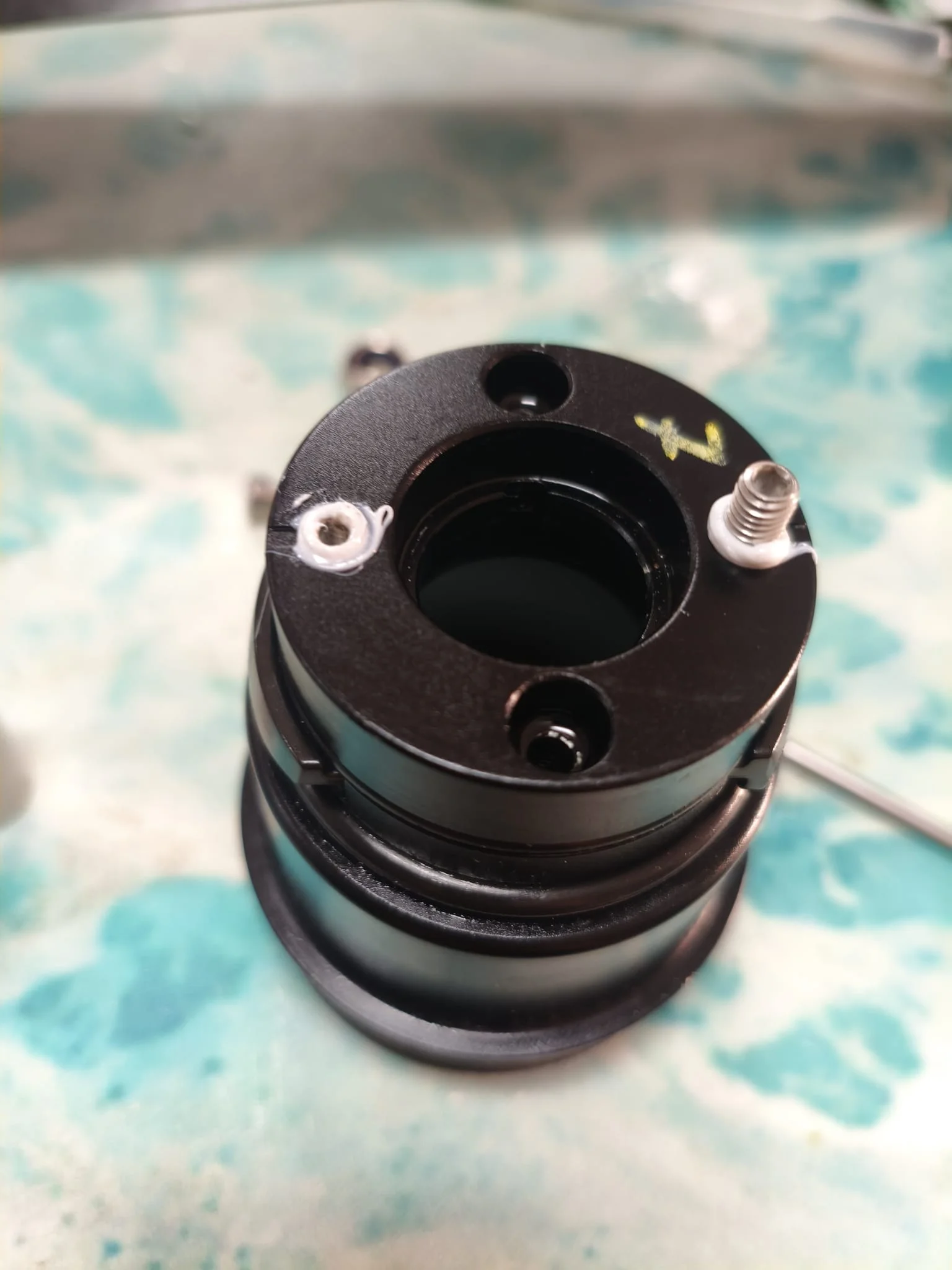
The Yearly Preventive Maintenance at our Marsaskala workshop is €568 and is the warranty-binding service Fliteboard mandates. Here’s exactly what we do on the bench:
- Flitebox Inspection and Flitebox Pressure Test — assemble, pressurise, monitor for any pressure drop. Pass / fail criteria from Fliteboard’s support documentation.
- Flange Check, Shaft and Pin Inspection — remove drive components, inspect for wear, micro-pitting, axial play.
- Propeller, Prop Guard and Anode Change — new parts fitted, old anode photographed and logged for ride-hour comparison.
- All O-Rings Replaced + Refill of Silicon Oil — every seal layer refreshed, oil topped up to spec.
- Mast and Board Inspection, Upper and Lower — carbon integrity, fitting torque, flange seal check.
- Software Updates — latest stable firmware pushed to controller and Flitebox.
- Controller Re-pairing — Bluetooth handshake verified, trigger throttle calibration.
- Service Report — photographic record + parts log + ride-hour reading delivered to the captain / management company at job close.
Add-on items at our published rates:
- Anode Kit Replacement: €25
- Collection And Drop-Off Service across Malta: €89
- Seals Repair: €575
- Fibreglass Repair: €540 (subject to extent of damage)
- Software Updates + New Remote Pairing: €150
- Flitecell Sport replacement: €2,400
- Flitecell Explore replacement: €3,400
- Replacement Remote Series 2: €380
- Flow 245 C Stabiliser wing: €255
- Prop Guard: €40
All prices are ex-VAT EUR at the time of writing; final invoiced amounts include 18% Malta VAT or apply French Commercial Exemption / temporary admission depending on the vessel’s flag and status.
Book a Flite Service before the 2026 charter season
Our Marsaskala workshop schedules Flite Services around 3–5 day Maltese stops. Standard Yearly Preventive Maintenance completes within 48 hours of board collection.
Mercer Yachting’s Mediterranean Service Rotation
The majority of charter-yacht Flite Service jobs we handle are scheduled around 3–5 day Maltese stops. Standard Yearly Preventive Maintenance completes within 48 hours of board collection if no major parts are required. Where a part has to ship from Fliteboard EU’s Netherlands warehouse, we book the service ahead so spares arrive before the board does. Workflow:
- Collection — we collect from the yacht in Maltese waters within 24 hours of booking. €89 fee covers collection and drop-off; same-day quayside service in Grand Harbour, Portomaso, Mgarr or Marsaskala is available where the yacht’s schedule allows.
- Workshop — Marsaskala bench, Fliteboard-authorised tooling, photo-documented service log.
- Pressure test + bench test — before the board leaves the workshop, the Flitebox is pressure-tested and the assembled board is bench-tested to confirm motor and controller pairing.
- Delivery back to yacht — with the service report, photographs of every component changed, ride-hour log update on the Flite App, and a fresh service sticker for the captain’s records.
For vessels elsewhere in the central Mediterranean we either arrange collection and workshop repair at a typical 5 to 7 working day door-to-door turnaround, or dispatch a technician via field service to Antibes, Palma, Monaco, Genoa, Athens or Split — whichever returns the board to the water faster. Same-day Flitecell spare-parts delivery to a yacht runs on our standard 5-day Mediterranean logistics route; worldwide air or sea freight is available for any nominated port or shipyard including Caribbean repositioning between seasons.
Frequently Asked Questions
Reviewed by Ryan Rizzo, Operations Lead, Ritz Marine Ltd · Published 24 May 2026
How often should I service a Fliteboard?
Fliteboard mandates a 1-year or 100-hour service for current Series 3, 2024 range, Marc Newson, Prop C and Flite Jet 1 systems — whichever comes first. The Flite Jet 2 (Jet C) and Flitescooter C powertrains have a longer 2-year or 200-hour interval. Older Series 1, 2 and 2.2 boards require a 6-month or 50-hour initial service (whichever first) plus 1-year or 100-hour ongoing. Service must be performed by an authorised partner or Fliteboard HQ to maintain warranty. The mandatory Yearly Preventive Maintenance at Mercer Yachting’s Marsaskala workshop costs €568 and covers Flitebox inspection plus pressure test, flange check, shaft and pin inspection, propeller, prop guard and anode replacement, software updates, O-ring replacement with silicon oil refill, and full mast and board inspection.
How should I store a Flitecell battery between rides?
Charge between 20% and 80% for ride-to-ride use. For storage longer than two weeks, set state of charge to 50–60% and store at room temperature (5–25°C, ideally 15–20°C). Never store below 0°C and never above 50°C. Cycle the battery at least once every three months to maintain coverage under Fliteboard’s warranty. Charge in a dedicated lithium-rated cabinet per MGN 681 (M) Amendment 1 requirements — not loose in a tender garage or guest cabin.
What is the Flitebox pressure test?
The Flitebox pressure test verifies the watertight seal of the eFoil drivetrain housing. Workshop pressure is applied to the assembled Flitebox via a calibrated gauge, then held to confirm no pressure drop indicating a leak. Mercer Yachting’s Marsaskala workshop runs this test as part of every €568 Yearly Preventive Maintenance — it’s the single most important check for catching seal degradation before it causes salt-water intrusion into the motor and battery compartments.
How much does it cost to skip a Fliteboard service?
Out-of-warranty repairs at an authorised service centre typically run €1,500 to €2,500 per incident. A premature Flitecell Explore replacement (caused by salt-water intrusion through a degraded seal) is €3,400; a Flite Sport battery is €2,400. A full motor and shaft rebuild — when salt water has reached the motor through a failed seal — can cost more than the original board. The €568 annual service is the cheapest insurance available against any of these failures, and skipping it voids warranty cover on parts that would otherwise be claim-eligible.
What needs checking mid-charter-season?
At the mid-season point (typically July–August in Mediterranean charter calendars), the priority checks are: anode wastage (anodes should be inspected every 6 months and replaced when more than half-wasted), connector and Flitecell lid seal condition for early signs of salt or moisture intrusion, board hull integrity (a single hard touchdown can spall the carbon at a wing or rail edge), and battery cycle count via the Flite App. Charter-intensity use accumulates cycles fast — a board doing 200 hours a season can hit its commercial-warranty 100-hour cap mid-July.
What does MGN 681 Amendment 1 mean for my eFoil batteries on board?
MGN 681 (M) Amendment 1 — published by the UK MCA on 19 December 2025 with clarifications added on 13 January 2026 — applies to yachts complying with Part A of the REG Yacht Code (typically commercial vessels). It requires that lithium batteries above 100 Wh hold third-party conformity (UKCA or equivalent) to IEC 62619 or IEC 62620, are stored in cabinets meeting EN 14470 / EN 16121 / EN 16122 with automatic temperature-rise detection and charge cut-off, gas venting, CCTV and smoke or gas detectors. A hard deadline of 1 January 2027 applies to UK-registered yachts for type-approved charging containers. For Fliteboard fleets, that means active lithium safety boxes (RAMBSS, RACLAN, LiVault) are no longer optional.
Where do you service Fliteboards?
Mercer Yachting handles Flite Service at our Marsaskala workshop in Malta. For yachts berthed at Grand Harbour, Portomaso, Mgarr or Marsaskala we offer same-day quayside service. For vessels elsewhere in the central Mediterranean we either arrange collection and workshop repair at a typical 5 to 7 working day turnaround, or dispatch a technician via field service to Antibes, Palma, Monaco, Genoa, Athens or Split — whichever returns the board to the water faster. Collection and drop-off across Malta is €89.
Can you service a Fliteboard during a 3-5 day yacht turnaround?
Yes. The majority of charter-yacht Flite Service jobs in our Marsaskala workshop are scheduled around 3–5 day Maltese stops. Standard Yearly Preventive Maintenance — Flitebox inspection plus pressure test, flange check, shaft and pin inspection, propeller, prop guard and anode replacement, software updates, O-ring replacement with silicon oil refill, full mast and board inspection — completes within 48 hours of board collection if no major parts are required. Where a part has to ship from Fliteboard EU’s Netherlands warehouse, we book the service ahead so spares arrive before the board does.