Between August 2021 and August 2022, 16 yachts were lost to fire. The MCA estimates that approximately half of the unexplained fires in that period are potentially attributable to lithium-ion battery failures (MGN 681, section 6). Lithium-ion fires are self-sufficient: they continue burning without additional oxygen, and produce off-gases including carbon monoxide, hydrogen, hydrogen fluoride, and hydrogen cyanide.
On 19 December 2025 the UK Maritime and Coastguard Agency published MGN 681 (M) Amendment 1, the first detailed guidance on storing and charging lithium-powered craft aboard yachts. This guide explains what MGN 681 requires, maps two verified product lines (RACLAN active safety boxes and ZARGES BatterySafe passive cases) to those requirements, and sets out the operational steps vessel operators need to take before the 1 January 2027 UK Type Approval deadline.
Mercer Yachting supplies lithium battery safety equipment for yachts from Malta, with delivery to any port worldwide. Request a quotation or read on for the full technical breakdown.
What MGN 681 (M) Amendment 1 Means for Your Vessel
MGN 681 (M) Amendment 1 is guidance published by the MCA that applies to yachts carrying small electrically powered craft (electric tenders, jet skis, e-foils, and personal watercraft) powered by lithium-ion batteries. It is based on the Red Ensign Group (REG) Yacht Code Part A, Chapter 14. The document establishes a clear precedence hierarchy: statutory requirements take priority over class rules, which in turn take priority over this guidance.
Key Thresholds
MGN 681 sets three battery capacity thresholds that determine what measures apply to your vessel:
- 100 Wh (section 4.2): Batteries exceeding this threshold trigger dedicated cabinet storage requirements. Spare batteries above 100 Wh must be stored in cabinets conforming to EN 14470, EN 16121, or EN 16122. Cabinets on open decks must be a minimum of 1.0 m from combustible materials, not placed on escape routes, and not adjacent to embarkation stations.
- 500 Wh aggregate: Crew awareness is required for smaller personal devices at this aggregate level.
- 10 kWh (section 4.23): This threshold triggers specific external storage and charging requirements for larger electrically powered craft.
For context, typical battery capacities in this sector are: e-foils 1–5 kWh, electric diver propulsion units 1–3 kWh, electric jet skis 20–50 kWh, and electric tenders 40–100 kWh. Most vessels carrying any of this equipment will exceed the 10 kWh threshold.
Temperature Limits
Ambient storage temperature must not exceed 45 °C (section 4.10). The same section notes that manufacturers estimate thermal runaway can begin at battery temperatures between 60 °C and 70 °C. The gap between maximum permitted storage temperature and thermal runaway onset is narrow, just 15–25 °C, which underscores why dedicated storage away from heat sources is essential.
Charging Space Restrictions
Charging spaces cannot be located (section 4.7):
- Forward of the collision bulkhead
- Inside Category A machinery spaces
- Adjacent to the main electrical power source
Batteries under charge must be a minimum of 1 m from these boundaries.
Structural Fire Protection
The required fire protection rating depends on vessel tonnage (section 4.11):
- A-60 for vessels of 500 GT and above
- A-30 for vessels below 500 GT
- B-15 for short-range vessels
Battery Conformity
Batteries above 100 Wh require a third-party conformity assessment (UKCA or equivalent) and must comply with IEC 62619 and/or IEC 62620 (section 4.4).
IMDG Code Amendment 42-24
Separately, IMDG Code Amendment 42-24 became mandatory on 1 January 2026. It increases references to lithium batteries, requires damaged or defective lithium batteries to be removed from articles and packaged separately, and mandates that all lithium batteries meet testing in the Manual of Tests and Criteria. Vessels transporting lithium batteries should verify compliance with these updated requirements.
RACLAN Active Safety Boxes: How They Work
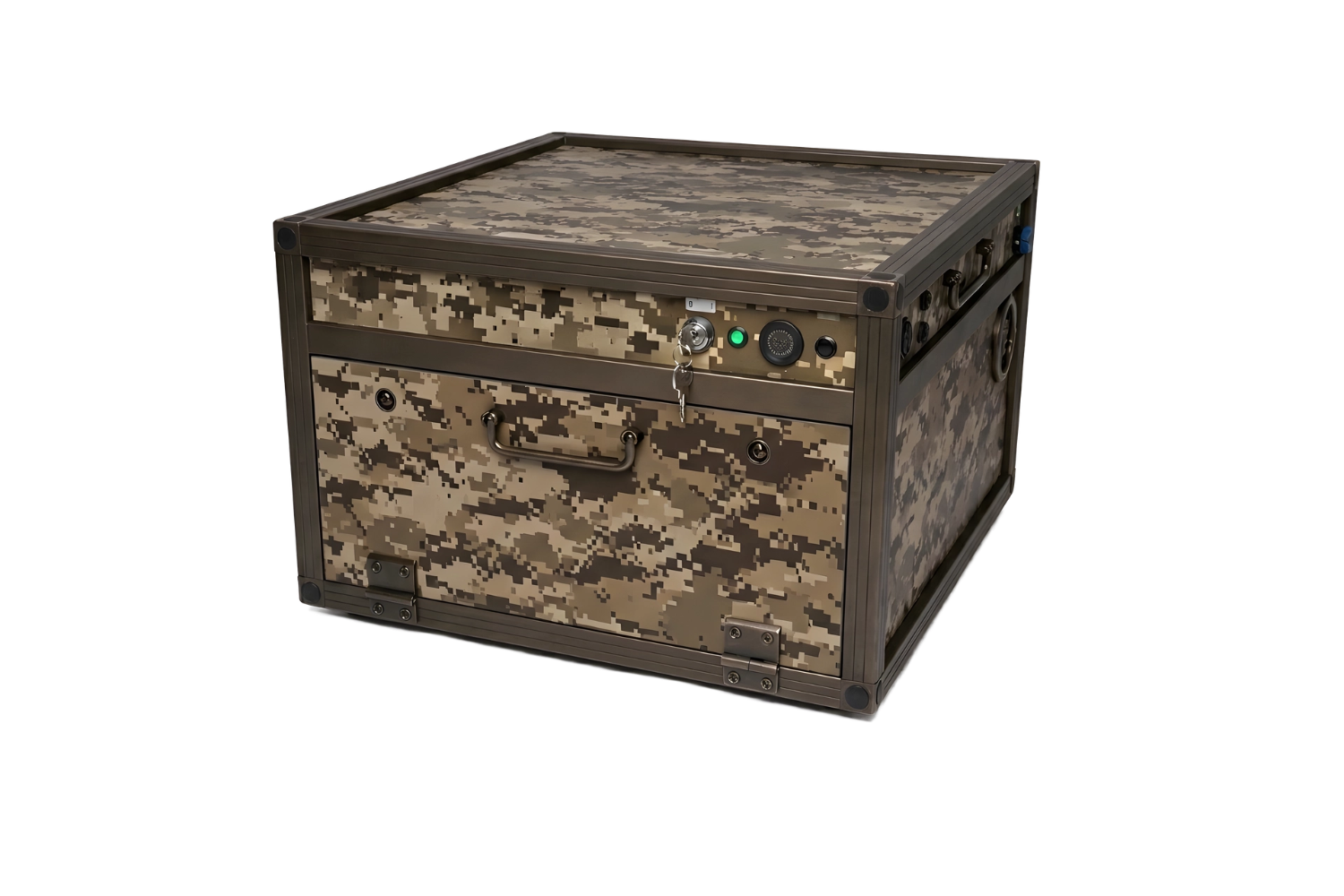
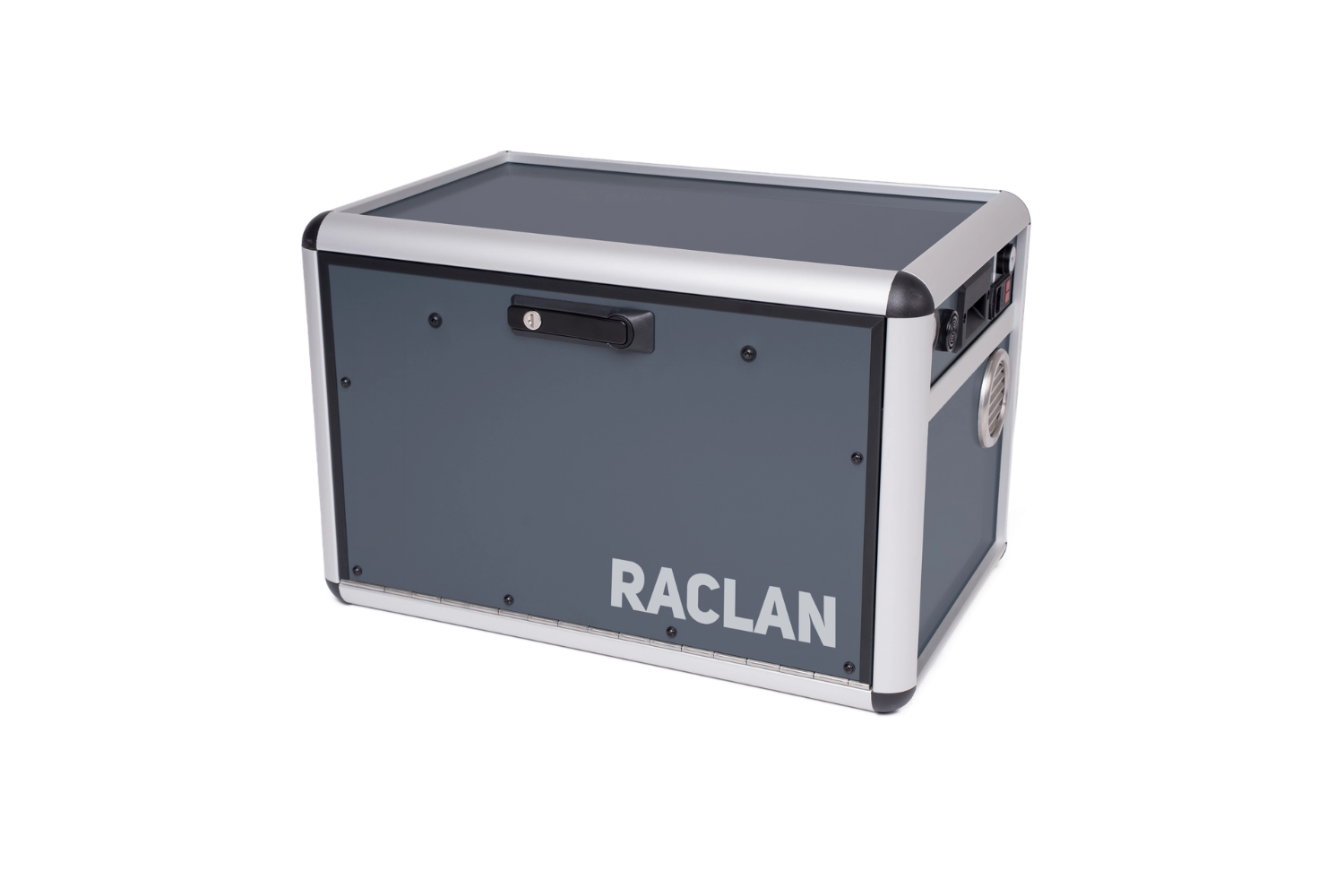
RACLAN produces active lithium fire safety boxes that combine containment with detection and suppression. Two models have verified specifications.
RACLAN Square
| External dimensions | 580 × 580 × 380 mm |
| Internal dimensions | 540 × 540 × 235 mm |
| Battery capacity | Up to 3.5 kWh |
| Extinguishing agent tank | 10 litres (TRIDENT®) |
| Certification | DMT TÜV Nord |
RACLAN Box II
| External dimensions | 580 × 380 × 380 mm |
| Internal dimensions | 540 × 340 × 200 mm |
| Battery capacity | Up to 1.754 kWh |
| Extinguishing agent tank | 5.5 litres (TRIDENT®) |
| Certification | DMT TÜV Nord |
Features Common to Both Models
Both the RACLAN Square and Box II share the following verified features:
- Fire-proof and explosion-proof high-tech composite material construction
- Acoustic alarm
- Optical function control
- Built-in emergency power supply
- Advanced exhaust system with toxin filter (hydrogen fluoride (HF) filtration)
- Waterproof
- Stackable
How RACLAN Features Align with MGN 681 Charging Cabinet Requirements
MGN 681 sections 4.12–4.13 specify that charging cabinets must provide:
- Charging with cabinet closed: RACLAN boxes are designed for batteries to charge inside the sealed unit.
- Internal temperature rise detection: RACLAN’s optical function control and alarm system support this requirement.
- Extinguishing medium application without opening: the TRIDENT® agent deploys automatically within the sealed box (10 litres in the Square, 5.5 litres in Box II).
- Off-gas venting: the advanced exhaust system with toxin filter addresses this requirement, including hydrogen fluoride (HF) filtration.
- Automatic charging stop on fault: operators should verify this capability with the unit’s control system for their specific installation.
- Suitable insulation and explosion protection: the fire-proof and explosion-proof composite construction is aligned with these requirements.
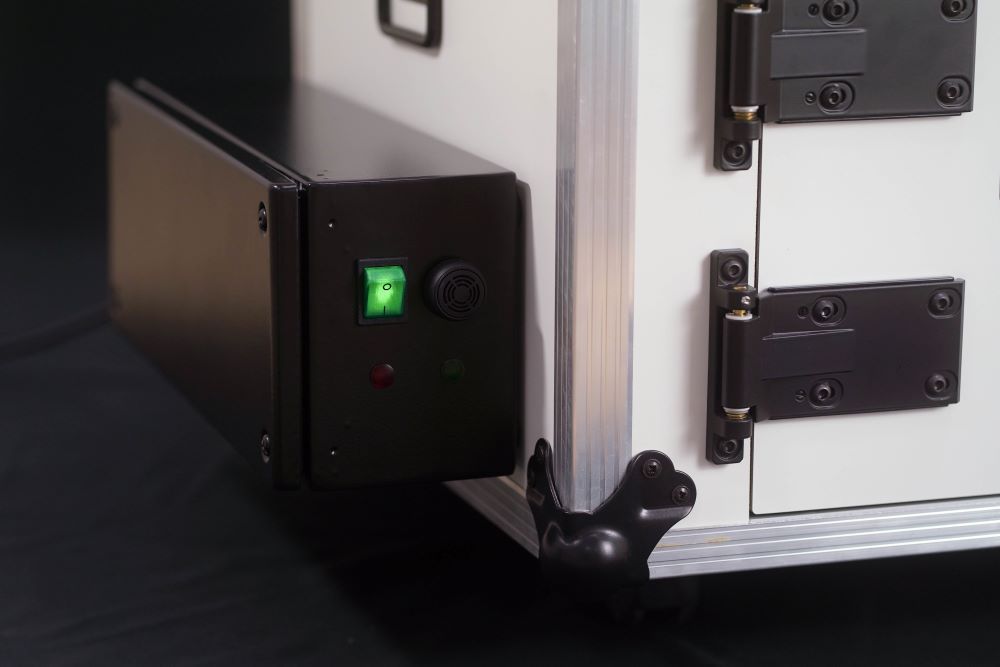
RAMBSS: Modular System Now Available
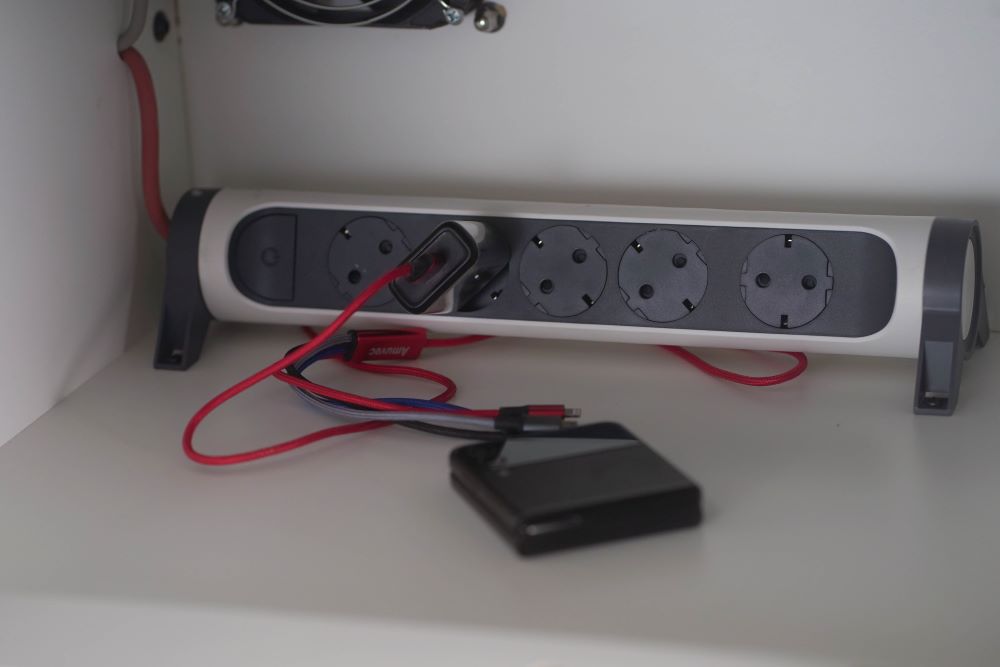
The RAMBSS (Raclan Maritime Battery Safety System) is a modular, stackable system with interlinked modules, designed for larger vessels requiring multiple interconnected safety zones. Lloyd's Register Design Appraisal certified (DAD: LR26434348SF), with WiFi monitoring and AMCS integration. Three module sizes available (up to 5.2 kWh). Request a quote or contact Mercer Yachting for specification.
ZARGES BatterySafe Cases: Storage and Transport
ZARGES BatterySafe cases provide passive containment for the storage and transport of lithium batteries. They are not active suppression systems; they contain thermal energy through material engineering rather than detecting and extinguishing fires.
Verified Specifications
| Shell material | Aircraft-grade aluminium |
| Lining | Fixed intumescent Cirrux glass-fibre |
| UN certification | UN Packing Group 1 (highest level for hazardous materials) |
| Additional certifications | 49 CFR, ATA 300 Category 1, IMDG |
| Testing | MIL-STD-810 tested; dust and water resistant |
| C-Series thermal containment | Tested up to 814 Wh |
| Weight (one model) | 11.5 kg |
| Range | Multiple models/sizes: C-Series, F-Series, eFoil-specific |
Important Limitation
ZARGES states that its BatterySafe cases are “not guaranteed to prevent thermal runaway from starting or spreading beyond the enclosure.” This is a critical distinction. ZARGES cases provide passive thermal containment for storage and transport, not active suppression. They are designed to buy time and limit damage, not to eliminate the event.
How ZARGES Cases Align with MGN 681 Storage Requirements
MGN 681 section 4.2 requires spare batteries above 100 Wh to be stored in dedicated cabinets conforming to EN 14470, EN 16121, or EN 16122. ZARGES BatterySafe cases — with their UN Packing Group 1 certification and MIL-STD-810 testing — support compliance with spare battery storage requirements within a vessel’s overall lithium battery safety arrangement. The operator should confirm with their surveyor that the specific ZARGES model selected satisfies the applicable EN standard for their vessel.
Choosing Between RACLAN and ZARGES
RACLAN and ZARGES serve different functions. Many vessels need both.
| Criterion | RACLAN (Square / Box II) | ZARGES BatterySafe |
|---|---|---|
| Protection type | Active: detection, suppression (TRIDENT®), exhaust filtration | Passive: thermal containment via aluminium shell + Cirrux lining |
| Primary use | Charging and storage onboard | Storage and transport (on/off vessel) |
| Charging inside unit | Yes, designed for sealed charging | No, passive containment only |
| Maximum battery capacity | Up to 3.5 kWh (Square) / 1.754 kWh (Box II) | C-Series tested up to 814 Wh; multiple sizes available |
| Certification | DMT TÜV Nord | UN Packing Group 1, 49 CFR, ATA 300 Cat 1, IMDG |
| Thermal runaway guarantee | Active suppression; verify coverage with manufacturer | Explicitly not guaranteed to prevent thermal runaway spreading |
| MGN 681 alignment | Aligned with charging cabinet requirements (sections 4.12–4.13) | Supports spare battery storage requirements (section 4.2) |
| Construction | Fire-proof/explosion-proof composite; waterproof; stackable | Aircraft-grade aluminium; intumescent Cirrux lining; MIL-STD-810 |
When You Need Both
A vessel carrying an electric tender (40–100 kWh) and two e-foils (1–5 kWh each) will typically need:
- RACLAN boxes in the designated charging space for active protection during charging, the highest-risk phase of battery operation
- ZARGES cases for spare batteries not under charge, for damaged batteries awaiting offload, and for shore-side transport of batteries for service or disposal
Browse the full range of lithium fire safety equipment or request a quotation for your vessel.
The 1 January 2027 Certification Deadline
MGN 681 section 5 states that all battery storage and charging containers placed on board UK-registered vessels must be UK Type Approved by a UK Nominated Body from 1 January 2027.
What This Means in Practice
- Any container used for storing or charging lithium batteries onboard a UK-flagged vessel must hold UK Type Approval from 1 January 2027.
- Equipment purchased before that date should be verified with the manufacturer or supplier to confirm whether it will meet the forthcoming Type Approval requirement.
- Vessel operators should engage with their classification society and flag state administration now to understand what documentation will be required.
What Vessel Operators Should Do Now
- Audit current equipment. Identify all lithium battery storage and charging containers currently onboard. Determine which hold third-party certification (DMT TÜV Nord, UN Packing Group 1, etc.) and which do not.
- Confirm Type Approval pathway. Contact equipment manufacturers or your supplier to confirm whether specific models are on track for UK Type Approval.
- Budget for replacement or upgrade. If existing equipment will not meet the 2027 requirement, plan procurement now to avoid supply bottlenecks as the deadline approaches.
- Document everything. Maintain records of equipment certificates, purchase dates, and manufacturer correspondence. Surveyors will expect this documentation.
Procurement Lead Times
Demand for certified lithium safety equipment is expected to increase as the 1 January 2027 deadline approaches. Contact Mercer Yachting to discuss availability and lead times for RACLAN and ZARGES equipment.
Crew Training and Operational Requirements
MGN 681 section 9 sets out crew training requirements. These aren't optional guidance; they're part of the overall safety framework that surveyors will assess.
Required Training Areas
- Safe operation, storage, and charging of lithium batteries
- Identification of battery damage
- Disposal and quarantine procedures for damaged batteries
- Drills at agreed intervals
Named Responsible Person
MGN 681 recommends appointing a named responsible person for lithium battery safety onboard. This person should oversee compliance with storage and charging procedures, manage training records, and coordinate with the vessel’s safety management system.
Early Warning Signs of Thermal Runaway
All crew should be trained to recognise these indicators (from MGN 681):
- Sounds: Hissing, whistling, or popping from a battery or device
- Smell: A sweet chemical smell
- Visual, black “smoke”: actually nanoparticles, not conventional smoke
- Visual, white vapour: indicates off-gassing has begun
Off-Gas Hazards
During thermal runaway, lithium-ion batteries emit CO2, CO, hydrogen, and volatile organic compounds. During an active fire, hydrogen chloride, hydrogen cyanide, and hydrogen fluoride may also be present. These gases are toxic and, in the case of hydrogen, flammable and potentially explosive.
Handling Damaged Batteries
MGN 681 is clear on damaged battery procedures:
- Store damaged batteries with extreme caution
- Unload at the first opportunity
- Never charge a damaged battery
- Be aware that damaged batteries may emit toxic and flammable gases even without visible signs of failure
Fire Detection and Suppression (Sections 7–8)
MGN 681 specifies the following detection and suppression infrastructure for battery storage and charging areas:
- Detection: Fixed smoke, heat, and gas detectors; CCTV at a continuously manned position; IR/thermal imaging is recommended
- Suppression: Automatic water-based system per SOLAS II-2; water-mist identified as most effective; minimum two portable extinguishers suitable for battery fires
- Ventilation: Mechanical ventilation extracting toxic and explosive gases, with capacity to remain below the lower explosion limit (section 4.16)
How to Specify Lithium Safety Equipment for Your Vessel
When preparing an RFQ for lithium battery safety equipment, provide the following information to ensure accurate specification and pricing.
RFQ Checklist
- Device inventory with battery capacities. List every lithium-powered device onboard with its battery capacity in Wh or kWh. Include e-foils, electric tenders, jet skis, diver propulsion units, drones, e-bikes, and power tools. This determines which MGN 681 thresholds apply (100 Wh, 500 Wh aggregate, 10 kWh).
- Vessel flag state and GT. This determines which structural fire protection rating applies (A-60, A-30, or B-15) and whether UK Type Approval will be required from 1 January 2027.
- Proposed charging locations. Identify where batteries are currently charged and where dedicated charging spaces could be established. Remember: not forward of collision bulkhead, not inside Category A machinery spaces, not adjacent to main electrical power source (MGN 681 section 4.7).
- Ambient temperature at storage locations. Storage must remain below 45 °C (section 4.10). Lazarettes and engine room-adjacent spaces in the Mediterranean summer regularly exceed this.
- Number of spare batteries requiring storage. Any spare battery above 100 Wh needs dedicated cabinet storage per EN 14470, EN 16121, or EN 16122.
- Transport requirements. If batteries need to be moved on or off the vessel (for service, disposal, or delivery), specify this; ZARGES cases with UN Packing Group 1 certification address this need.
- Classification society and surveyor. Identify your class society so that equipment can be specified with the appropriate documentation for survey.
- Existing fire detection and ventilation. MGN 681 sections 7–8 require specific detection (smoke, heat, gas, CCTV) and mechanical ventilation in battery areas. Note what is already installed.
Request a Quotation
Send your completed checklist to ops@merceryachting.com or use our online quotation form. We will return a specification covering recommended RACLAN and ZARGES equipment, mapped to MGN 681 requirements for your vessel.
Frequently Asked Questions
What is MGN 681 and does it apply to my yacht?
MGN 681 (M) Amendment 1 is guidance published by the UK Maritime and Coastguard Agency on 19 December 2025, based on the Red Ensign Group (REG) Yacht Code Part A, Chapter 14. It applies to yachts carrying small electrically powered craft (electric tenders, jet skis, e-foils, and personal watercraft) powered by lithium-ion batteries. The guidance triggers specific storage and charging requirements for batteries above 100 Wh (section 4.2). If your vessel is UK-flagged and carries any lithium-powered craft with batteries exceeding this threshold, MGN 681 applies.
What is a RACLAN box?
RACLAN produces two verified models of active lithium fire safety box. The RACLAN Square (external 580 × 580 × 380 mm, internal 540 × 540 × 235 mm, up to 3.5 kWh capacity, 10-litre TRIDENT® extinguishing agent tank) and the RACLAN Box II (external 580 × 380 × 380 mm, internal 540 × 340 × 200 mm, up to 1.754 kWh, 5.5-litre tank). Both are certified by DMT TÜV Nord and feature fire-proof and explosion-proof high-tech composite construction, acoustic alarm, optical function control, built-in emergency power supply, and an advanced exhaust system with toxin filter for hydrogen fluoride (HF).
Are ZARGES cases guaranteed to prevent thermal runaway?
No. ZARGES states that its BatterySafe cases are “not guaranteed to prevent thermal runaway from starting or spreading beyond the enclosure.” ZARGES cases provide passive thermal containment for storage and transport, using an aircraft-grade aluminium shell with a fixed intumescent Cirrux glass-fibre lining, and carry UN Packing Group 1 certification. The C-Series is tested for thermal containment up to 814 Wh. They are not active suppression systems.
What is the 100 Wh battery threshold?
Under MGN 681 (M) Amendment 1, section 4.2, batteries exceeding 100 Wh trigger dedicated cabinet storage requirements. Spare batteries above this threshold must be stored in cabinets conforming to EN 14470, EN 16121, or EN 16122. Cabinets on open decks must be a minimum of 1.0 m from combustible materials, and must not be placed on escape routes or adjacent to embarkation stations.
Do I need a lithium fire safety box by 1 January 2027?
Under MGN 681 (M) Amendment 1, section 5, all battery storage and charging containers placed onboard UK-registered vessels must be UK Type Approved by a UK Nominated Body from 1 January 2027. Vessel operators should confirm that any lithium safety equipment purchased before that date will meet the forthcoming Type Approval requirement.
What standards should battery storage cabinets meet?
MGN 681 section 4.2 requires dedicated cabinets to conform to EN 14470, EN 16121, or EN 16122. Batteries themselves should hold third-party conformity assessment (UKCA or equivalent) and comply with IEC 62619 and/or IEC 62620 per section 4.4.
Sources
- MGN 681 (M) Amendment 1: “Fire Safety and Storage of Small Electric Powered Craft on Yachts,” UK Maritime and Coastguard Agency, published 19 December 2025. gov.uk/government/publications/mgn-681-m-amendment-1
- ZARGES BatterySafe — product specifications, UN Packing Group 1 certification details, and thermal containment disclaimer. zargesusa.com/products/batterysafe
- IMDG Code Amendment 42-24: summary of changes effective 1 January 2026. westpandi.com/news-and-resources/news/september-2024/solas-amendments-to-the-imdg-code-(amendment-42-24