The Cell Is Its Own Oxidiser
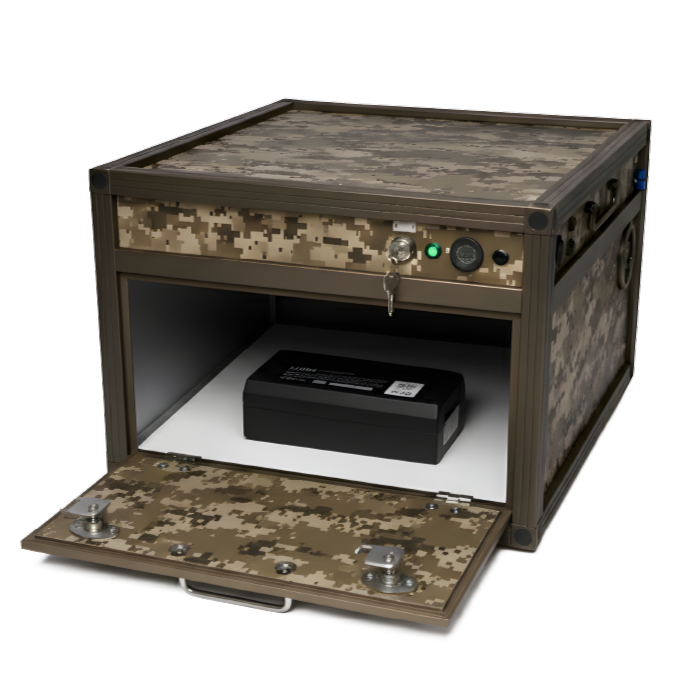
The reason ordinary fire suppression fails on lithium-ion batteries is chemical, not technical. Thermal runaway is a staged failure: the SEI (solid-electrolyte interphase) layer on the anode begins breaking down around 80–120 °C, the separator melts around 135–160 °C, and for NMC or NCA cathodes the cathode itself begins decomposing and releasing oxygen above ~200 °C. (LFP cathodes are materially more thermally stable.) Once the cathode is releasing its own oxygen, the reaction is self-sustaining. Every conventional fire-extinguishing agent on the market — CO2, FM-200 / Novec 1230 / other clean gases, dry powder, AFFF foam — works by interrupting the oxygen supply at the flame. But you cannot starve a reaction that carries its own oxidiser.
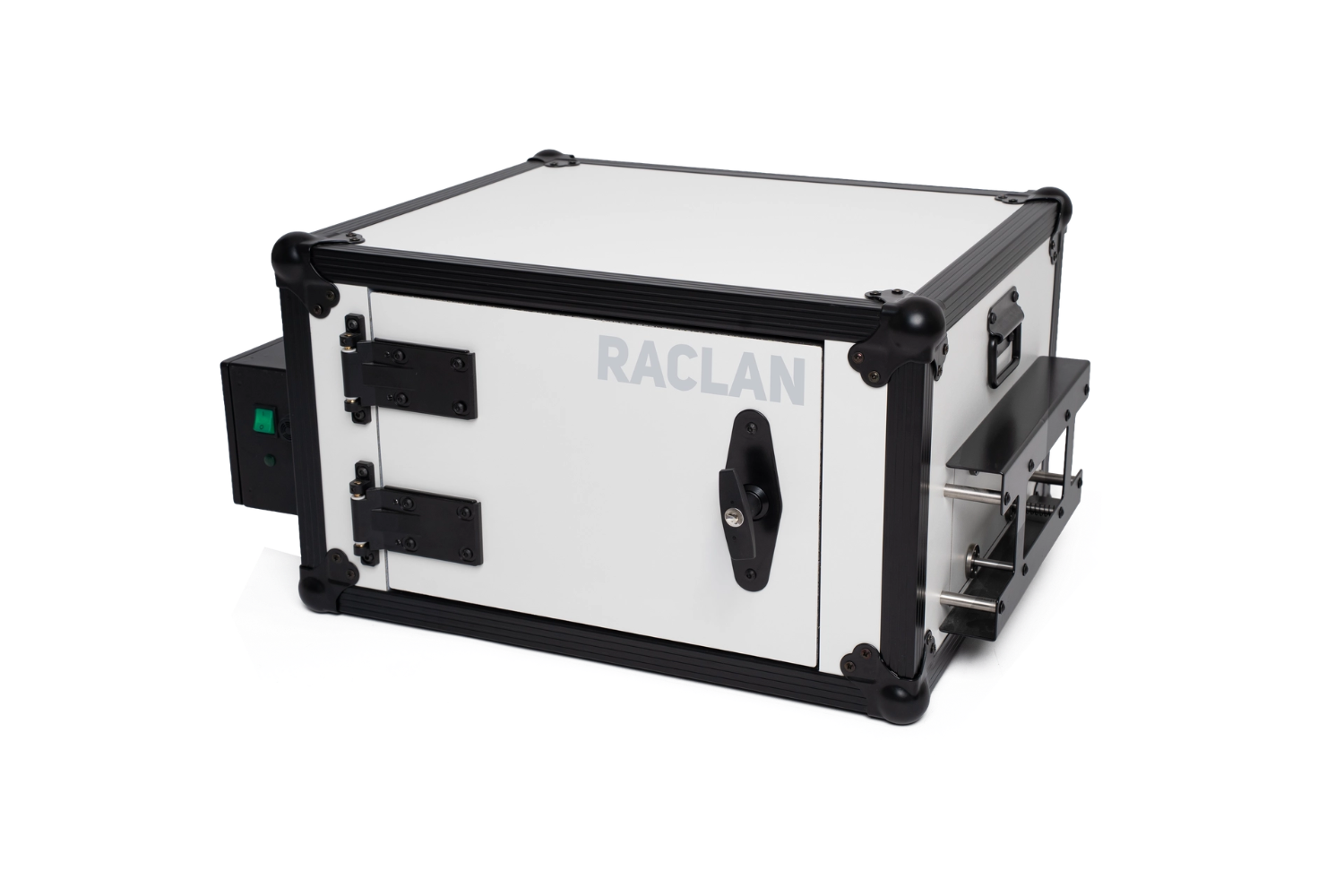
What works on a lithium-ion fire is heat extraction (cool the failing cell back below the cathode-decomposition threshold) and physical isolation (stop one failing cell from heating its neighbours to ignition temperature). Everything inside a RACLAN box exists to perform one or both of those two jobs, in stages, with redundancy. This guide walks through what each component does and why it's built the way it is — from the resin-densified-wood outer shell to the proprietary water-based cooling agent inside.
If you operate a superyacht with lithium-powered toys onboard — an eFoil, Seabob, electric tender, jet ski, or even an e-bike for the crew — the relevant safety standard is MGN 681 (M) Amendment 1, published by the UK MCA on 19 December 2025 with updated text issued 13 January 2026. The 1 January 2027 deadline in section 5.1 of that Marine Guidance Note is what's driving most current procurement enquiries. The engineering is what determines whether the product you spec today is actually capable of doing the job MGN 681 describes.
Who Actually Makes RACLAN
Before walking through the components, it's worth knowing the manufacturing chain — because each link in it owns a specific piece of the engineering.
TechnoPhysik Engineering GmbH in Essen, Germany is the parent. Founded 1989, specialises in vermiculite-based fire protection and industrial thermal insulation. FISACON GmbH in Rheda-Wiedenbrück manufactures the RACLAN and RAMBSS product lines and works closely with the TechnoPhysik group; the two operate in coordination on the RACLAN range. MINERALKA d.o.o. in Cerknica, Slovenia is the in-group subsidiary that produces the FIPRO vermiculite panels which form the inner non-combustible layer of every RACLAN. LiVault is the UK-facing brand under which the products are distributed into the marine market. Mercer Yachting is the exclusive dealer for the full RACLAN and LiVault product range in Malta, Greece and Sicily.
The product line itself originated in 2017. According to a 2024 interview with developer Rainer Daniel, the brief came from UK Special Forces: design a lightweight, mobile box for the safe handling of lithium-ion batteries in field conditions. That defence-driven origin is why the boxes are blast-rated as well as fire-rated — an engineering choice that became commercially relevant on superyachts a few years later, when the same risk profile (high-energy lithium packs, confined spaces, slow response time) emerged in the toy-and-tender locker.
1. The Structural Sandwich: Panzerholz Outside, FIPRO Inside
Open up a RACLAN and the first thing visible is that the wall isn't a single material. It's a deliberate composite: an outer shell of Panzerholz® (a resin-densified wood, German DIN 7707-1) wrapped around an inner layer of FIPRO vermiculite-based non-combustible board. Each material handles a different failure mode.
Panzerholz — the blast layer
Panzerholz — literally “tank wood” — is hardwood veneer (typically beech) impregnated with phenolic resin and compressed under heat and pressure until the resin fills the cellular voids in the wood. The finished material has a density above 1,300 kg/m3 — heavy enough that it sinks in water. It's the same material used in WWII tank armour and in modern German VIP-vehicle ballistic kits.
Two properties matter for a battery enclosure. First, fire performance: Panzerholz holds a B-s1, d0 classification under EN 13501-1 — that's the best fire class available short of a true non-combustible (A1/A2). B means combustible but with very limited contribution to fire; s1 means quasi-no smoke (the highest smoke class); d0 means no flaming droplets. For a wood-based material that's exceptional. Second, blast handling: the resin-densified structure absorbs energy from internal deflagration the way armour-plate absorbs spalling. RACLAN literature references rated containment of internal hydrogen explosion overpressure up to 7.2 bar.
Why not steel? Steel is fire-resistant but a very effective heat conductor — roughly two orders of magnitude higher than a phenolic-densified wood (around 50 W/m·K for steel versus the order of 0.2 W/m·K for Panzerholz). In a sustained internal fire, a steel-walled box transmits heat to the outer surface and to anything it's bolted to — deck timber, adjacent enclosures, bedding compartments. Panzerholz keeps the outer surface comparatively cool. Why not GRP/FRP composite? Because most marine glass-reinforced polyester or vinyl-ester composites burn under sustained heat exposure — the resin matrix contributes to fire load. Panzerholz combines the best of both: structural blast containment plus low external surface temperature.
FIPRO — the non-combustible inner liner
FIPRO is a vermiculite-based panel produced by Mineralka. Expanded vermiculite mineral aggregate is bonded with an inorganic binder — critically, no organic resin in the matrix, so the board carries no fuel load. It is Bureau Veritas MED-certified (manufacturer reference 07000) as a non-combustible material under the EU Marine Equipment Directive 2014/90/EU. The certification supports A-, B- and C-class SOLAS bulkhead constructions.
Vermiculite has a useful chemical trick: its layered crystal structure holds bound water. When the inner liner heats up, the layered crystal structure releases that water progressively from around 100 °C up to ~600 °C — absorbing latent heat across exactly the propagation window where you most need it. Once the bound moisture is gone, the residual mineral structure remains stable to around 1,200 °C without releasing toxic decomposition products. The published toxicity test (University of Pittsburgh) classifies FIPRO as non-toxic in fire.
Why vermiculite specifically? Ceramic fibre wool gives similar thermal performance but is friable and EU-classified as a carcinogen (Cat 1B for refractory ceramic fibre); not suitable for crew-handled equipment. Calcium silicate boards are similar but denser and have less bound moisture for the steam-cooling effect. Intumescent coatings are wrong tool for the job — they're designed to swell outward from a fire source and rely on organic binders that char. Vermiculite wins on the combination: non-combustible, non-toxic, non-friable, machinable, with a useful steam-cooling phase change.
2. The Door Interlock: Why the Seal Matters as Much as the Lock
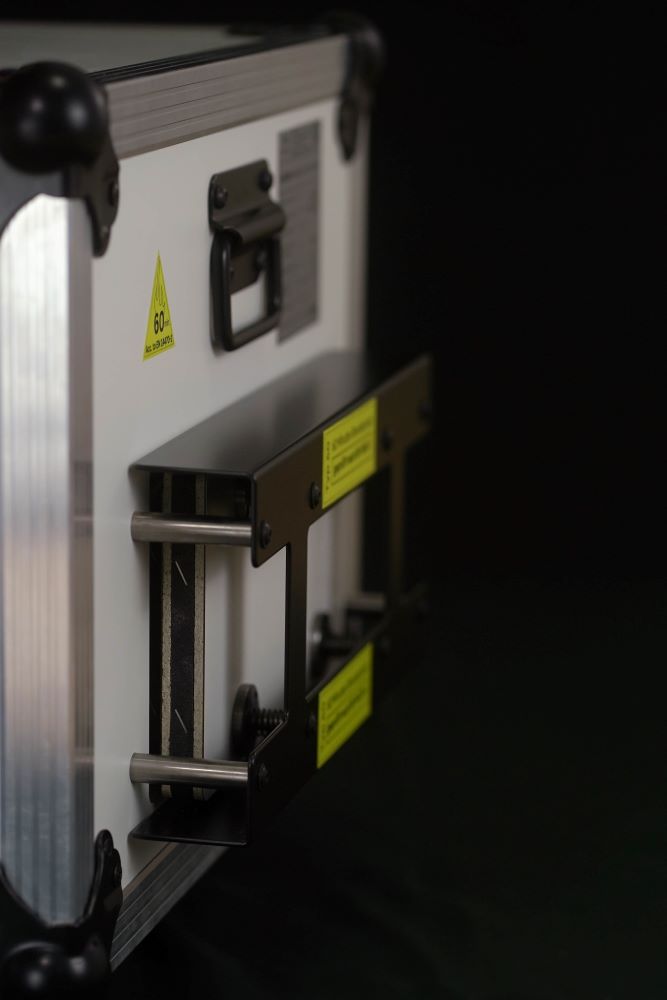
A safety box that won't stay closed during an event is just a slow-motion fire vector. The door system on a RACLAN has to do three jobs simultaneously: stay sealed against the internal blast overpressure of a deflagration, stay sealed against the off-gas plume so toxic gases don't bypass the filter and enter the cabin space, and (in active variants) physically prevent charging while open.
The XellBox C user manual lists the door interlock as a chained series of safety steps: the door switch is mechanically linked to the charging circuit (no charging unless the door is fully closed and latched); the latch engages a magnetic cold-smoke damper that closes the ventilation path between the box and the exterior until thermal trigger; the smoke detector and temperature sensors are positioned such that an open or unlatched door registers a fault. The sequence is designed so that the operator can't accidentally leave the box in a state where charging proceeds but containment is incomplete.
The seal itself is a continuous gasket around the door perimeter, behind the lock face. The Panzerholz door has enough mass and rigidity that an internal deflagration doesn't pop the seal momentarily and vent into the cabin — the energy budget is absorbed by the wall material. Watertight variants (RACLAN Square Marine Box) add IP-rated sealing for outdoor deck-mounted installations.
3. Detection: Smoke, Heat, and the Off-Gas Question
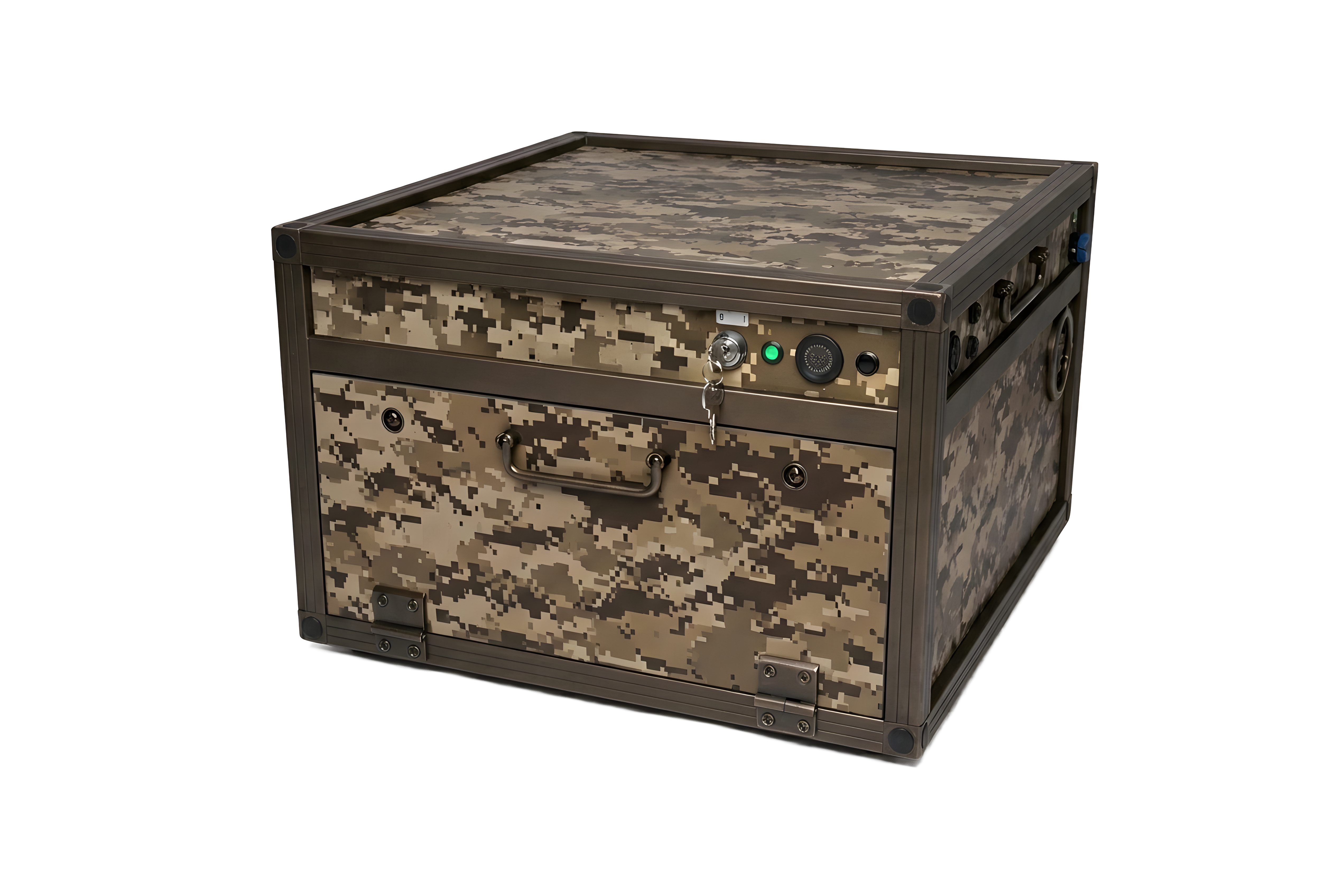
The XellBox C bill of materials (manual section 6.2.4) names the smoke detector specifically: an ABUS OptiSmoke RM1000, EN 54-tested. It uses an optical chamber to detect smoke particles — the standard photoelectric principle — with a sensitivity calibrated for early-stage lithium off-gas, not just open flame. There is also a thermostat tied to the internal extraction fan and a temperature sensor in the cell space, monitored continuously by the control electronics.
The detection question is more subtle than it appears. A failing lithium cell does produce smoke and heat — but the most diagnostic early signal is actually the off-gas itself. Hydrogen, carbon monoxide, hydrofluoric acid, methane and hydrocarbon volatiles begin venting from the cell pressure-relief disc before flaming combustion starts. The published consensus in the academic literature (multiple peer-reviewed sources, including the Larsson et al. study in Scientific Reports, 2017) is that gas-based detection gives the earliest warning window.
RACLAN's primary detection is smoke + temperature. MGN 681 (M) Amendment 1 does not currently require off-gas detection (the relevant text in section 7 indicates that off-gas detectors are not required at the cabinet level, though they may form part of the wider space-monitoring architecture). For most superyacht applications, smoke + temperature is sufficient to trigger containment well before propagation; the larger off-gas concern is downstream, at the ventilation and filtration stage.
The detection signals feed into a control unit with an OLED touchscreen on the box face, WiFi alarm output, and (in RAMBSS and select RACLAN variants) integration with the vessel's Alarm Monitoring and Control System (AMCS) under REG Yacht Code REG-A 14.1(5)(c). When a fault is detected, the box automatically cuts the charging circuit, releases the suppression agent, and signals the bridge.
Operating note
The CHIRP report on a Lift eFoil battery thermal runaway documents a case where the failure occurred more than 18 hours after a charge that “showed no abnormalities.” The crew first noticed the issue from a manual temperature check — the battery was sitting at 37 °C versus ambient, then rose to 47 °C overnight. The point isn't that something failed in detection. The point is that a battery without active monitoring gives essentially zero warning. Active boxes give you that warning and a chance to act before propagation begins.
4. TRIDENT: The Wet Cooling Agent
The suppression agent inside a RACLAN is called TRIDENT. Manufacturer literature describes it as approximately 97% water plus a proprietary surfactant and additive package. The exact chemistry is not publicly disclosed — this is a closed-formula manufacturer claim, not an independently published specification. What is well-established is the function: it is a water-based wetting and cooling agent, not a clean gas, not a foam, not a dry chemical.
Two stages of action are at work. First, the surfactant package reduces the surface tension of the water carrier so the agent penetrates between cells and wets cell casings, where dry-powder and gaseous agents cannot reach. Second, the water base extracts heat by evaporation. For a lithium-ion thermal runaway — where the only effective interrupt is cooling the cell below the cathode-decomposition threshold — this is the right physics.
The peer-reviewed literature backs this up. Studies in Energies (MDPI, 2023) and the FAA Technical Centre tests (TC-13-53) consistently find that water-based agents and water mist are the most effective extinguishants for lithium-ion fires, because cooling is the determining factor. Clean gases like FM-200 and Novec 1230 are effective at flame knockdown but provide negligible cooling — once the gas dissipates, residual heat re-ignites the cells. AFFF foam suffers similar limitations and carries PFAS environmental concerns increasingly non-grata on yachts. Dry chemical extinguishers do nothing for cell-stack heat and foul electronics.
TRIDENT volumes in the RACLAN range: the RACLAN Box holds 5.5 litres; the RACLAN Square Marine Box holds 10 litres (an e-foil-specific variant carries 11 litres); the RAMBSS module range carries similar volumes per module, with the larger Module 3 size adding sustained-cooling capacity. Discharge is pressure-free — the agent is released by gravity and overpressure of a separate pressurant, not stored under pressure permanently in the suppression tank. Manufacturer literature describes the agent as biodegradable and not harmful to health, suitable for discharge in an enclosed environment without crew evacuation requirements.
The 10-year refill cycle quoted by the manufacturer is a maintenance claim that we recommend revisiting during refit and survey rather than treating as a fit-and-forget interval. The agent is water-rich so the biocide stability is plausible; the better practice is to inspect at every yard period and replace if the seal or fill level shows any change.
5. Off-Gas: Why Ventilation Plus Filtration Matters
Even after suppression has cooled the cell stack, the residual off-gas inside the box is a problem. Lithium-ion runaway produces a defined cocktail: hydrogen (combustible, low ignition energy), carbon monoxide (toxic, asphyxiant), hydrofluoric acid (acutely toxic; IDLH of 30 ppm), methane and ethylene (combustible hydrocarbons), plus carbon dioxide, HCN, and benzene as supporting cast.
The quantitative reference figure most often cited is from the Larsson, Andersson and Mellander study in Scientific Reports (2017): lithium cells in thermal runaway produce 20 to 200 mg of HF per Wh of battery capacity. For a 1.5 kWh eFoil pack, that's 30 to 300 grams of HF — orders of magnitude above the IDLH limit if released into a yacht interior.
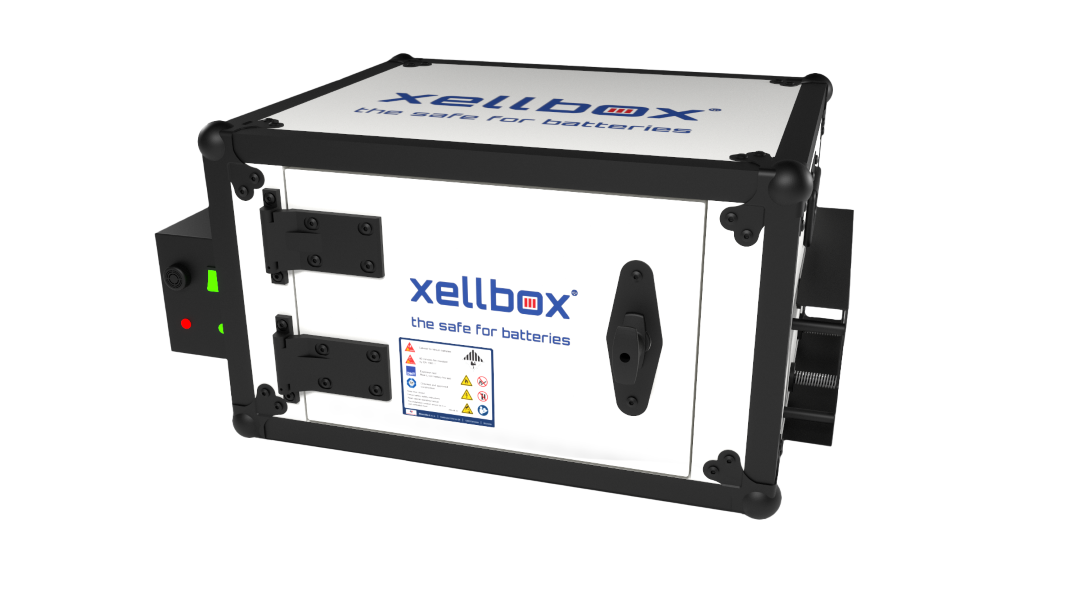
RACLAN handles this with two mechanisms in sequence. First, ducted mechanical extraction: an internal fan thermostatically triggered (the XellBox C manual specifies an air-change rate of approximately 30 air changes per hour at 4.1 m3/h flow). The fan starts when the temperature sensor crosses threshold and continues until the internal atmosphere returns to baseline. The extraction is ducted — not just released into the cabin space — meeting the requirement in MGN 681 (M) Amendment 1 section 4.16 for ducted mechanical ventilation tied to the REG Yacht Code REG-A 14.1(5)(c) provisions.
Second, chemical filtration on the exhaust path. The RACLAN Square Marine Box uses Sorbacal® SP as the toxin-filter media — a high-surface-area calcium hydroxide product specifically formulated for hydrogen fluoride sorption. The HF binds to the Ca(OH)2, neutralising the corrosive plume before it leaves the enclosure. Additional VOC adsorbent media handle the hydrocarbon components. The Square Marine Box's filtration is what allows the box to be installed inside a tender garage or engine room with confidence that the off-gas plume won't reach the rest of the vessel.

6. Active Charging vs Passive Storage: Why It Matters Where the Cell Fails
One of the most consequential architectural decisions in the RACLAN range is the split between active (charging-rated) and passive (storage-only) variants. Most of the boxes Mercer Yachting supplies are active — meaning the box integrates a charging interface that allows the lithium pack to be charged inside the certified enclosure rather than outside it.
The reasoning is statistical. The single highest-risk phase in a lithium battery's life is the charge cycle — or, more precisely, the hours immediately following it. The CHIRP eFoil case demonstrates the failure mode: a charge that appeared completely normal, followed by a thermal runaway around 24 hours later, with the battery progressing from 37 °C at routine inspection to 47 °C the next day before the master ordered it ditched overboard. If charging happens inside an active box, the sensors detect the over-temperature, cut the charging current, and trigger suppression before propagation begins. If charging happens outside the box, the runaway is fully unconfined at onset — and attempting to move a runaway-stage battery into a box by hand is itself dangerous.
MGN 681 (M) Amendment 1 codifies this. Section 4.12.1 requires that “charging activities take place while the charging cabinet is closed.” Section 4.12.2 requires “ability to detect temperature rises with indication of over-temperature events.” Section 4.12.3 requires “a suitable extinguishing medium to be applied to the battery in the event of a battery fire without opening the cabinet.” The active-charging architecture is what makes a single product satisfy all three at once.
Passive boxes still have a place — for transport (the ZARGES K470 / BatterySafe series is the industry default for UN3480/UN3481 transport quarantine), for cold-storage of spare packs that aren't in active rotation, and as a backup containment vessel during a manual battery move. But for the charging cycle itself, the active architecture is the regulatory floor.
7. RAMBSS: The Modular Architecture for Superyachts
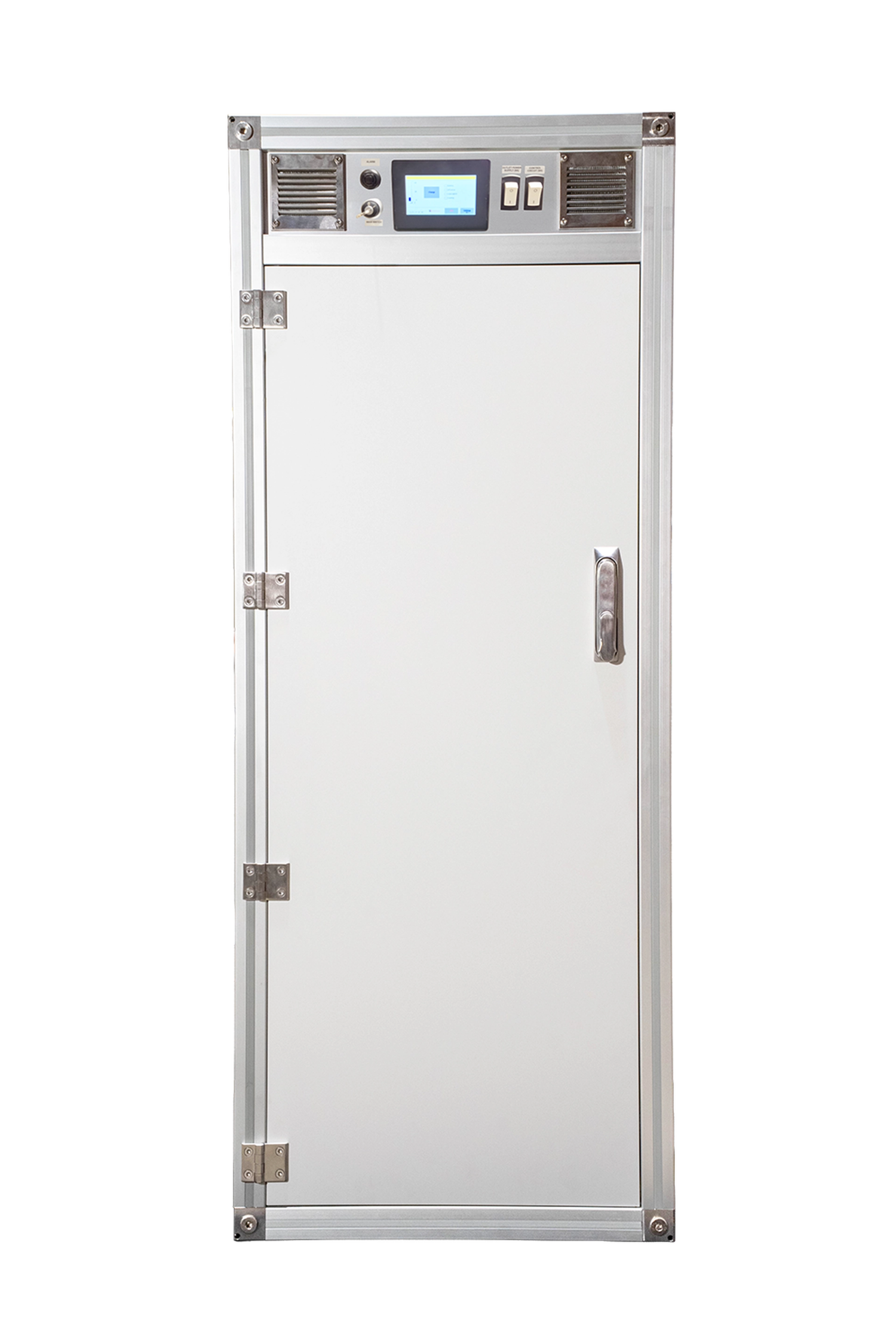
The RACLAN single-box variants work for one to a small handful of lithium packs. A charter superyacht with a full toy inventory — multiple eFoils, several Seabobs, electric tenders, jet ski packs, e-bikes for the crew — can have 8 to 20 lithium batteries in active rotation across a season. That's where RAMBSS (Raclan Maritime Battery Safety System) comes in.
RAMBSS is a modular system. Three module heights — 500 mm, 750 mm, and 1,500 mm — sit on a common 600 × 600 mm footprint. Modules connect mechanically and electrically. The 500 mm module (Module 1) handles up to 4.35 kWh; the 750 mm (Module 2) and 1,500 mm (Module 3) handle up to 5.25 kWh each. A typical configuration on a 60 m yacht might be three Module 1 cabinets stacked on top of a single Module 3 cabinet — total height around 3 m, total capacity around 18 kWh, footprint 0.36 m2.
What's different from running multiple independent RACLAN boxes is the two-stage suppression. RAMBSS uses TRIDENT on the first detection of over-temperature, exactly like the single-box variants. If the runaway persists, the system can flood the affected module with water for sustained cooling — full submersion of the cells. This is consistent with the academic consensus that cooling, not extinguishing, is the determining factor in arresting Li-ion runaway, especially in the propagation phase where adjacent cells are heating but not yet failing.
RAMBSS holds a Lloyd's Register Design Appraisal Document — DAD reference LR26434348SF, dated 11 November 2024. The DAD is a substantive class-society review of the system's design against LR's marine rules; it is the foundation for the eventual UK Type Approval submission once the relevant UK Nominated Bodies are designated.
8. The Certifications Stack — What Each One Actually Covers
A glance at the back of a RACLAN box turns up several certification marks, with shorthand that's not always self-explanatory. Here's what each one means in practice.
- DMT TÜV Nord (test programme M02/22). DMT GmbH is part of the TÜV Nord group, with a major battery and fire test facility in Dortmund accredited under ECE R100 Appendix 8E. The DMT test programme for RACLAN covers internal deflagration / explosion resistance and fire-plus-gas behaviour as two separate test reports. This is the practical European equivalent of a UL 1487 listing in the United States — the same product class (Battery Containment Enclosures), the same test philosophy. The current certificate runs to 10 December 2029.
- Lloyd's Register DAD for RAMBSS specifically. Reference LR26434348SF, dated 11 November 2024. As discussed above, this is a class-society design review — substantive engineering sign-off, valid for five years from issue, and the foundation for a future UK Type Approval submission. Not all RACLAN variants carry a DAD; RAMBSS is the one that does.
- Bureau Veritas MED 07000. This is the Marine Equipment Directive certificate for the FIPRO non-combustible board, issued by BV. It's a wheelmark certification: EU-flagged vessels must use MED-certified materials in fire-safety-critical applications, and the 07000 number is the BV reference. The certification is based on ISO 1182 non-combustibility testing and the IMO 2010 FTP Code toxicity test.
- IEC 62619 / IEC 62620. These apply to the lithium cells inside the box, not to the box itself. MGN 681 section 4.5 requires that batteries above 100 Wh hold appropriate third-party Conformity Assessment such as UKCA or equivalent and comply with one of these standards. This is the toy or tender manufacturer's responsibility — not RACLAN's — but it's worth confirming when speccing a fleet.
Note the gap: there is no UK Type Approval yet on any RACLAN product. UK Type Approval under MGN 681 (M) Amendment 1 section 5.1 will be issued by UK Nominated Bodies, which are still being designated under the Merchant Shipping (Marine Equipment) Regulations 2025 at time of writing. The DMT and LR positions are the strongest class-society endorsements available in the meantime. When the UK Type Approval framework is operational, expect TechnoPhysik to be among the first to submit.
Speccing a RACLAN / RAMBSS installation for a refit or new build?
Mercer Yachting is the exclusive dealer for Malta, Greece and Sicily. We coordinate spec, supply, installation and after-sales.
9. The 1 January 2027 Cliff Edge
If you're reading this in 2026, MGN 681 (M) Amendment 1 section 5.1 is what's driving most current RACLAN procurement enquiries on UK-flagged superyachts. The text:
“All Lithium-Ion battery storage and charging containers/boxes placed on board UK registered vessels must be UK Type Approved and certified.”
MGN 681 (M) Amendment 1, section 5.1 — effective 1 January 2027The deadline applies to UK-registered vessels specifically; the underlying functional requirements (sections 4.5 through 4.16) apply more broadly and are now being mirrored in Malta CYC 2020 section 11.2.1.4 and Marshall Islands Maritime Administrator MI 103 (2021). Either you're on a UK flag and you have a hard deadline, or you're not on UK flag but your insurer and management company are increasingly asking the same questions.
What we recommend for speccing today:
- Spec products that already meet the functional requirements of MGN 681 — active charging cabinet, water-based suppression, ducted mechanical ventilation, blast containment, alarm integration. RACLAN and RAMBSS meet all of these.
- Confirm your supplier is committed to submitting for UK Type Approval as soon as the Nominated Body framework is operational. TechnoPhysik has the DMT and LR positions in place; the UK TA pathway is the next step.
- Document the spec decision now. Even if the formal UK TA isn't issued until late 2026, a vessel installation completed in 2026 with a product whose manufacturer has a credible TA path is in a better commercial position than one with a product whose certification path is unclear.
- Plan the installation, not just the box. MGN 681 also requires storage-space-level ventilation, A-class structural fire boundaries (A-60 for ≥500 GT, A-30 below), and integration with the vessel's alarm management system. The box alone isn't compliance — it has to be installed correctly into a compliant space.
10. What Captains Should Ask Their Refit Yard
Two questions clarify a lot when you're sitting in a refit meeting and the topic is lithium safety:
- What's the suppression medium? If the answer is “clean gas” (FM-200 / Novec) or “dry powder,” the proposed solution is not the right tool for the job. Lithium-ion runaway needs cooling, which needs a water-based agent. If the answer is “active water-based agent inside a sealed cabinet,” you're in the right product category.
- Where does the off-gas go? If the answer is “vented into the engine room” or “passive release through a flap,” that's a problem. Toxic and corrosive off-gases need ducted mechanical extraction plus chemical filtration. If the answer is “through a filtered duct to the exterior of the vessel,” you're in MGN 681 compliance territory.
Two more questions for the technical level:
- Charging interface inside the box? Active variants only. The standard for new builds and major refits should be that every routine charge cycle happens inside a certified enclosure.
- Integration with the AMCS / bridge alarm? Standalone boxes are useful but the right architecture has the cabinet's smoke/temperature/fault signals tied into the vessel's alarm management. RAMBSS supports this natively; the AMCS link is part of MGN 681's expected design intent.
Beyond the engineering, the regulatory question is which flag and class society applies. UK-flagged vessels have a 1 January 2027 deadline. Malta-flagged vessels have CYC 2020 section 11.2.1.4. Marshall Islands has MI 103 (2021). These instruments are converging on the same functional standard — the question for any individual vessel is how soon the deadline applies, not whether it applies.
Frequently Asked Questions
Why don't standard fire extinguishers work on lithium battery fires?
A lithium-ion cell in thermal runaway generates its own oxygen as the cathode decomposes above roughly 150 °C. Smothering agents (CO2, FM-200, Novec, dry powder, AFFF) interrupt the oxygen supply at the flame but cannot interrupt a reaction that carries its own oxidiser. The only mechanisms that arrest a Li-ion runaway are heat extraction (cooling the cell below the cathode-decomposition threshold) and physical isolation. Water-based agents do both.
What is TRIDENT made of?
Manufacturer literature describes TRIDENT as approximately 97% water plus a proprietary surfactant and additive package. Exact chemistry is not publicly disclosed. The function is dual: surfactants reduce surface tension so the agent wets cell casings and penetrates between cells; the water base extracts heat by evaporation. Described as biodegradable and not harmful to health.
What is Panzerholz and why use it instead of steel?
Phenolic-resin-densified hardwood per DIN 7707-1. Density above 1,300 kg/m3 (sinks in water). B-s1, d0 fire classification under EN 13501-1 — the best fire performance available short of a true non-combustible. Used for the RACLAN outer shell because it combines blast containment, very low thermal conductivity (around 0.18 W/m·K versus 50 for steel) and machinability. Same material used in WWII tank armour and modern German VIP-vehicle ballistic kits.
What does the Bureau Veritas MED certificate on FIPRO actually cover?
FIPRO is the vermiculite-based non-combustible board produced by Mineralka (a TechnoPhysik subsidiary). The BV MED Type Examination Certificate (number 07000) certifies it as a non-combustible material under the EU Marine Equipment Directive 2014/90/EU, suitable for SOLAS A-, B- and C-class bulkhead constructions. Test basis: ISO 1182 non-combustibility plus IMO 2010 FTP Code toxicity testing.
Why is charging inside the safety box safer than charging outside it?
Statistically, most lithium-toy fires originate during or shortly after charging. The CHIRP report on a Lift eFoil battery in marine service documents a thermal runaway roughly 24 hours after a charge that “showed no abnormalities.” If charging happens inside an active box, sensors detect over-temperature, cut the charging circuit, and release suppression before propagation begins. MGN 681 (M) Amendment 1 section 4.12 codifies this: charging must take place with the cabinet closed, with over-temperature detection and a suitable extinguishing medium that can be applied without opening the door.
What is the difference between a Lloyd's Register DAD and a Type Approval?
A Design Appraisal Document is LR's design-review document — it confirms the engineering has been reviewed against LR's rules. A Type Approval Certificate adds the requirement that production samples have been independently tested and the manufacturing line surveyed. The RAMBSS DAD (LR26434348SF, 11 November 2024) is a substantive class-society review and the foundation for an eventual UK Type Approval submission under MGN 681 section 5.1.
Does RACLAN comply with MGN 681 right now?
RACLAN and RAMBSS satisfy every functional requirement in MGN 681 (M) Amendment 1: active detection, closed-cabinet charging, water-based suppression, ducted ventilation, internal blast containment, AMCS integration. They carry DMT TÜV Nord certification plus (RAMBSS) the LR DAD. The 1 January 2027 cliff edge in section 5.1 adds an additional requirement for UK-registered vessels: storage and charging containers must hold UK Type Approval issued by a UK Nominated Body. UK Nominated Bodies are still being designated. We recommend speccing now and tracking the UK TA programme through the supplier.
Need a RACLAN or RAMBSS spec for your vessel?
Mercer Yachting handles spec, supply, installation and after-sales across Malta, Greece and Sicily.